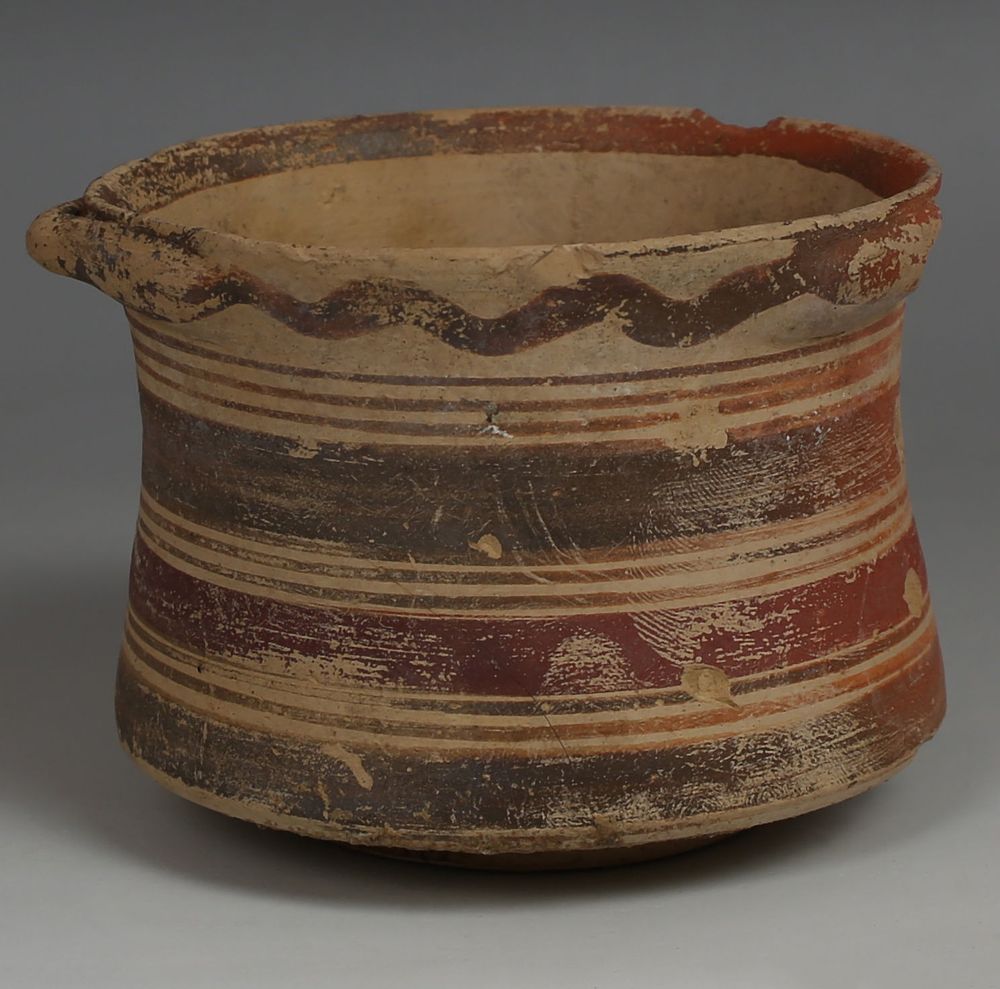
Subasta Bidspirit | Etrusco-Corinthian vessel
Etrusco-Corinthian vessel - ITEM: Vessel MATERIAL: Pottery CULTURE: Etrusco-Corinthian PERIOD: 7th - 6th Century B.C DIMENSIONS: 70 mm x 102 mm CONDITION: Good condition PROVENANCE: Ex European private collection, Ex Lakythos S.A.R.L (1987), Ex Galerie Hydra, Geneva, Switzerland (1984) Comes with Certificate of Authenticity and Export Licence. If you are from outside the European Union, we will have to apply for the export licence again for your country, this takes 3 to 5 weeks and has a cost of 5% of the hammer price, this amount will be added to the final invoice. The Etrusco-Corinthian vessels represent a significant phase in Etruscan pottery production, specifically flourishing during the Orientalizing Period (roughly 700–600 BCE). This style emerged when Etruscan potters, exposed to the highly desirable pottery imported from Corinth (Greece), began to actively imitate the Athenian city's sophisticated techniques and distinctive decorative motifs. The resulting Etrusco-Corinthian ware typically features a pale clay body and utilizes the black-figure technique, where silhouetted figures are painted onto the light surface and enhanced with incised lines and added red and white colors. Etruscan artists successfully replicated the shapes of Corinthian vessels, such as the aryballos (small perfume flask), olpe (pitcher), and kotyle (small deep cup), which were popular items of trade and social display. The most recognizable characteristic adopted from Corinth was the ”animal frieze” motif. Etrusco-Corinthian vessels are heavily decorated with bands of real and fantastic creatures—including lions, panthers, goats, deer, and mythological beasts like sphinxes and griffins—often arranged in orderly procession. A defining feature is the use of rosettes or floral elements as ”filling ornaments” to completely cover the background space, a stylistic trait known as horror vacui (fear of empty space) borrowed directly from their Greek models. While skillfully executed, the Etruscan imitations often demonstrate a less precise execution of the figures and a flatter, more stylized rendition compared to the dynamic, detailed naturalism of the original Corinthian works. Despite the heavy reliance on Corinthian influence, the Etrusco-Corinthian style was not merely a copy; it reflected Etruscan tastes and sometimes incorporated unique elements, especially in later examples. For instance, the Etruscan potters sometimes included scenes with local mythological figures or applied colors in ways that diverged from the strict Greek canon. These vessels played a critical role in the Etruscan economy, satisfying the elite demand for luxury items used in symposia (drinking parties) and funerary rites. Ultimately, this period of intense emulation provided a foundational skill set and decorative vocabulary that would evolve into the later, more distinctively Etruscan black-figure and red-figure styles, illustrating the complex cultural interchange that defined the ancient Mediterranean.