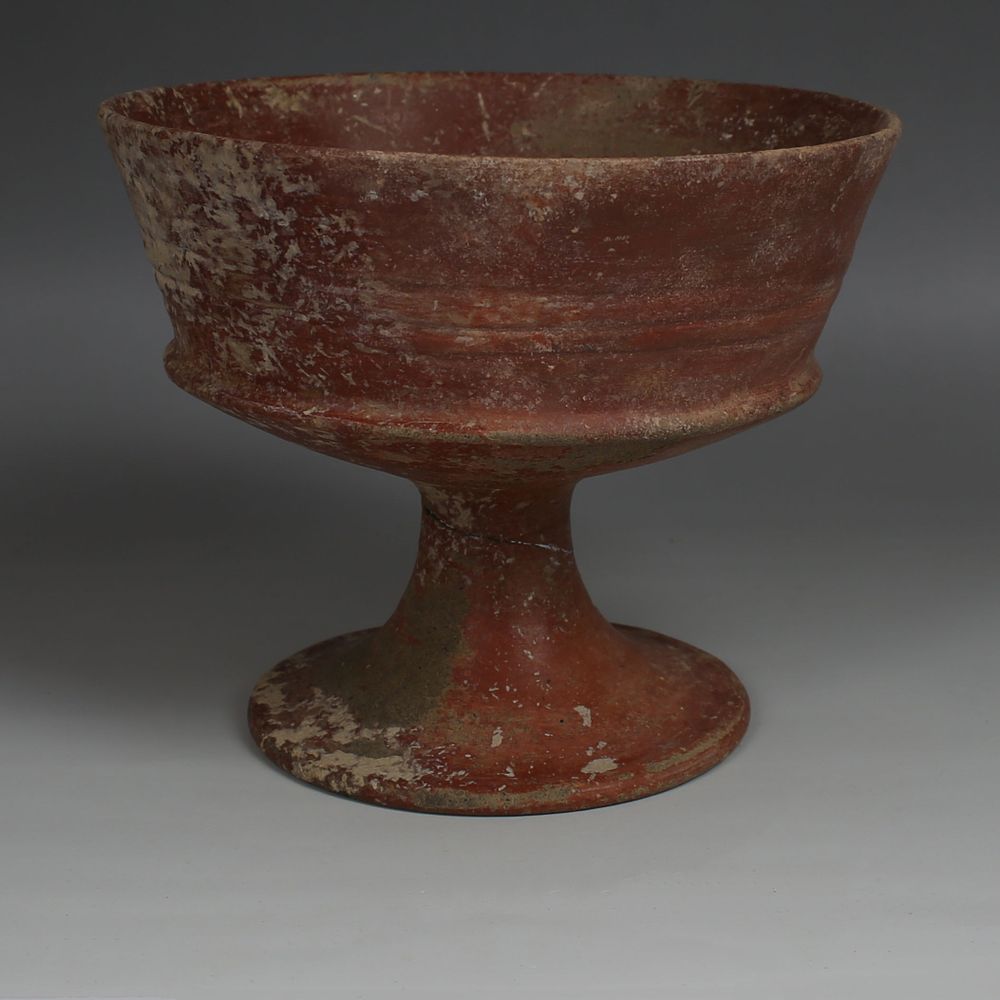
Subasta Bidspirit | Etruscan chalice
Etruscan chalice - ITEM: Chalice MATERIAL: Pottery CULTURE: Etruscan PERIOD: 4th - 3rd Century B.C DIMENSIONS: 128 mm x 158 mm CONDITION: Good condition, repaired PROVENANCE: Ex Belgian private collection, Ex Spanish antiquities dealer (2022), Ex Belgian private collection, Brussels Comes with Certificate of Authenticity and Export Licence. If you are from outside the European Union, we will have to apply for the export licence again for your country, this takes 3 to 5 weeks and has a cost of 5% of the hammer price, this amount will be added to the final invoice. Impasto is the earliest and most basic form of indigenous Etruscan pottery, characteristic of the preceding Villanovian culture and continuing into the early phases of the Etruscan civilization (c. 9th–7th centuries BCE). This coarse ware is defined by the composition of its clay, which is unrefined and contains noticeable chips of mica or stone inclusions (temper). Impasto vessels were typically handmade rather than wheel-thrown, resulting in thick walls, simple forms, and an often uneven, porous surface texture. Fired at low temperatures, the colors of Impasto pottery vary widely from dull brown to red, and decoration, when present, usually consists of crude incised or impressed geometric patterns made before firing. Emerging in the 7th century BCE, Bucchero ware represents the Etruscans' major technical and artistic contribution to pottery. It is the signature fabric of the Etruscan elite and is immediately recognizable by its uniform jet-black color and striking, highly polished, metallic sheen. The black color is achieved through a controlled reduction firing process, which starves the kiln of oxygen, causing the iron oxide in the clay to turn black throughout the vessel body. Bucchero forms, which include kantharoi (cups) and oinochoai (jugs), were often inspired by and designed to imitate expensive metal vessels like silver, offering a sophisticated, locally produced alternative for banquets and funerary rites. While Impasto and Bucchero were distinctly Etruscan developments, the third major category of Etruscan pottery involves vessels that were either directly imported from Greece or locally produced in imitation of Greek styles. The Etruscans were enthusiastic consumers of Greek painted vases—particularly Corinthian and Attic black-figure and red-figure wares—which were highly prized for their narrative scenes and fineware quality. Etruscan potters responded by creating their own local versions, such as ”Pontic” vases or Etrusco-Corinthian ware, incorporating Etruscan mythological and cultural motifs into the Greek decorative schemes. This synthesis of indigenous techniques (like Impasto and Bucchero) with foreign influences demonstrates the Etruscan culture's commercial reach and its ability to adapt and integrate external artistic ideas.