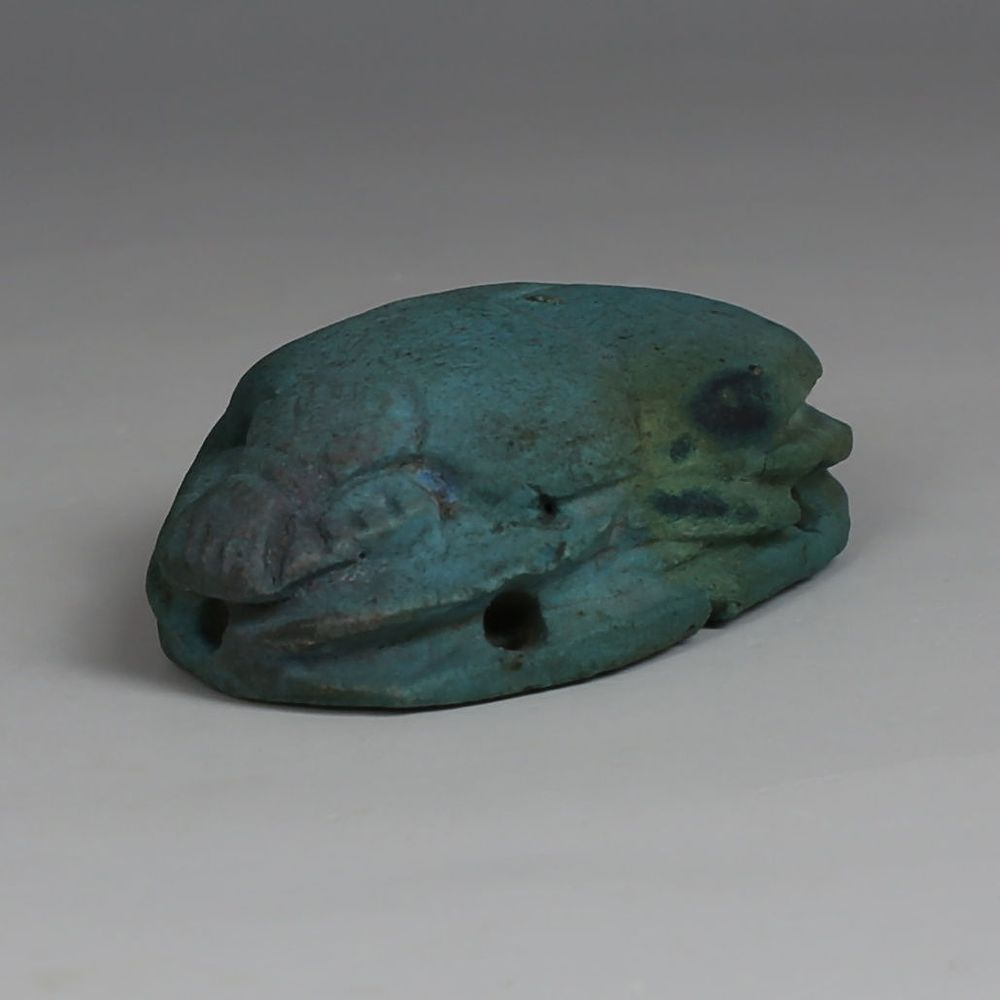
Subasta Bidspirit | Egyptian scarab from mummy wrappings
Egyptian scarab from mummy wrappings - ITEM: Scarab from mummy wrappings MATERIAL: Faience CULTURE: Egyptian PERIOD: Late period, 664 - 332 B.C DIMENSIONS: 19 mm x 34 mm x 53 mm CONDITION: Good condition PROVENANCE: Ex English private collection, 2019, who bought it at auction arround 1988. Before that it came from a French collection which was formed in the 1950´s PARALLEL: The Brooklyn Museum, Accession number 49.28a-c. The Metropolitan Museum of Art, Object number 89.2.388 Comes with Certificate of Authenticity and Export Licence. If you are from outside the European Union, we will have to apply for the export licence again for your country, this takes 3 to 5 weeks and has a cost of 5% of the hammer price, this amount will be added to the final invoice. The scarab beetle was a powerful and multifaceted religious symbol in ancient Egypt, fundamentally representing renewal, rebirth, and the rising sun. This association stemmed from the Egyptians observing the common dung beetle (Scarabaeus sacer) rolling balls of dung across the ground, an action they likened to the sun god Khepri rolling the solar disc across the sky each morning to ensure its daily rebirth. As such, scarabs were among the most crucial amulets placed with the deceased. Crafted from materials like glazed steatite (faience), green jasper, basalt, or carnelian, they were worn by the living for protection and good fortune, but their most significant role was in the funerary context, where they were often sewn or wrapped directly into the mummy wrappings. Within the mummy wrappings, the most important form was the Heart Scarab . This larger amulet was typically placed directly over the heart of the deceased or sometimes rested on the throat or chest. Its function was purely religious and magical, designed to safeguard the dead during the most critical moment of their journey into the afterlife: the Weighing of the Heart ceremony in the Hall of Two Truths. In this judgment, the deceased’s heart—the seat of their intellect, memory, and conscience—would be weighed against the feather of Ma'at, the goddess of truth and cosmic order. If the heart was heavy with misdeeds, it would be devoured by the demon Ammit, resulting in the annihilation of the soul. To prevent this devastating outcome, Heart Scarabs were often inscribed on their flat base with a version of Chapter 30B of the Book of the Dead. This magical spell was a plea, imploring the heart not to testify against its owner's past actions when questioned by the gods. The inscription typically begins with a phrase like, ”O my heart which I had from my mother, O my heart which I had from my mother, O my heart of my different forms, do not stand up as a witness against me...” By combining this compelling injunction with the form of the beetle, which guaranteed the cyclical nature of existence, the scarab ensured the heart's silence and the deceased's safe passage, thereby securing their transition into an akh (a blessed spirit) in the afterlife.