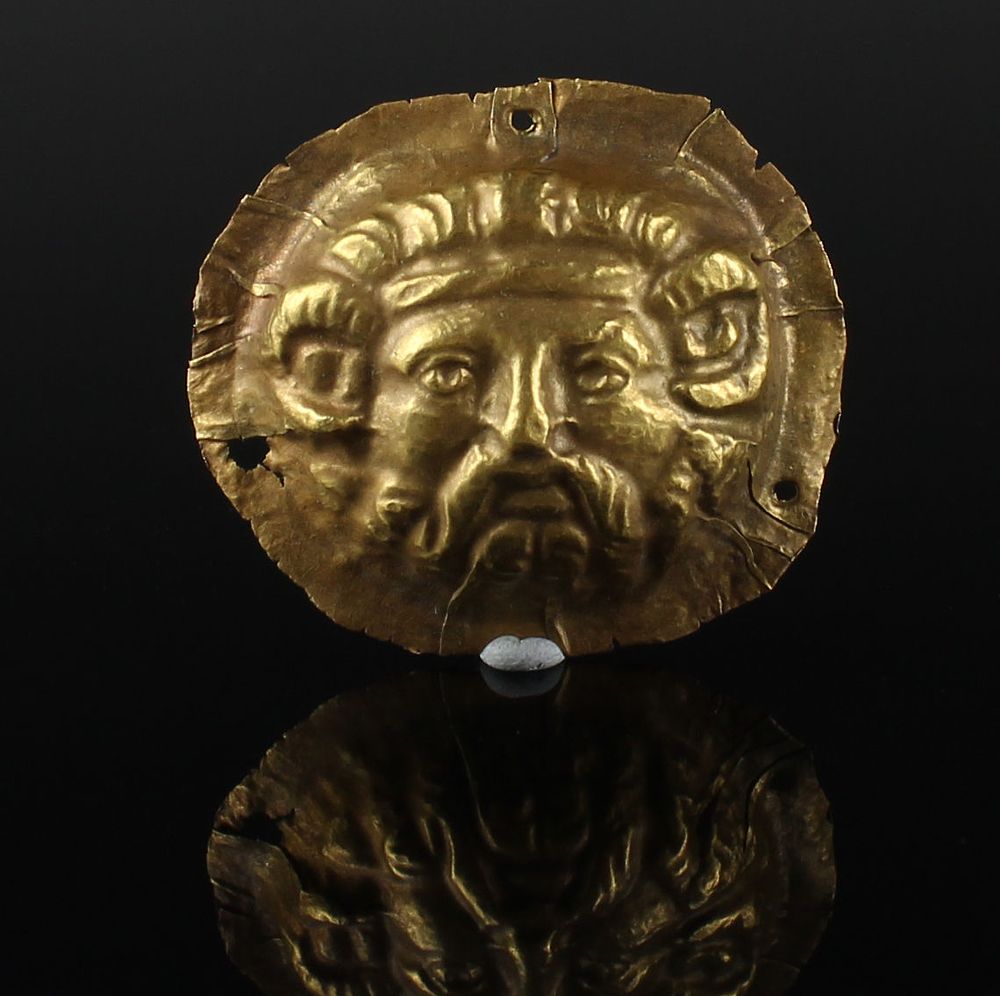
Subasta Bidspirit | Head applique depicting Zeus Ammon
Head applique depicting Zeus Ammon - ITEM: Roman head applique depicting Zeus Ammon MATERIAL: Gold, Repoussé technique CULTURE: Roman PERIOD: 1st - 2nd Century A.D CONDITION: 33 mm x 40 mm PROVENANCE: Ex American private collection, acquired at Harmer Rooke Galleries (August, 1998) Comes with Certificate of Authenticity and Export Licence. If you are from outside the European Union, we will have to apply for the export licence again for your country, this takes 3 to 5 weeks and has a cost of 5% of the hammer price, this amount will be added to the final invoice. The Roman conception of Zeus Ammon, known primarily as Jupiter Ammon, represents a significant example of religious syncretism in the ancient world. This merged deity combines the attributes of the Greek supreme god, Zeus, with the Egyptian ”king of the gods, ” Amun (also spelled Ammon). The original syncretism began among the Greeks, particularly in their colony of Cyrenaica on the North African coast and was closely associated with the famous Oracle of Amun at the Siwa Oasis in the Libyan desert. The Roman identification with Jupiter was a natural extension of the Greek association, as Romans had long regarded their own chief deity, Jupiter, as the equivalent of the Greek Zeus. The iconography of Jupiter Ammon is distinct and easily recognizable, setting it apart from the traditional bearded, thunderbolt-wielding Roman Jupiter. The syncretic god is typically depicted with a mature, bearded human face, but is conspicuously adorned with the spiral ram's horns of the Egyptian god Amun, a symbol associated with Amun's creative potency and divinity. This visual blending highlights the cultural exchange that took place in the Mediterranean, where Romans readily adopted and adapted foreign deities into their religious framework. The Romans considered the revered North African oracle an embodiment of their own supreme god, allowing the cult to flourish. The cult of Jupiter Ammon gained great renown in the classical world, largely due to the visit of Alexander the Great in 331 BCE. At the Siwa Oracle, Alexander was reportedly declared the ”son of Amun, ” a proclamation that reinforced his own divine status and cemented the god's reputation as a prophetic deity of immense power. The Romans, absorbing the Hellenistic tradition, continued to revere Jupiter Ammon in this role. The deity is featured in Roman literature, such as Virgil's Aeneid, where Dido invokes Jupiter Ammon to assert her power and seek divine guidance. The presence of artifacts like Roman copies of Greek sculptures of Zeus Ammon, dating to the Imperial period, testifies to the enduring significance of this syncretic god in the Roman religious imagination.