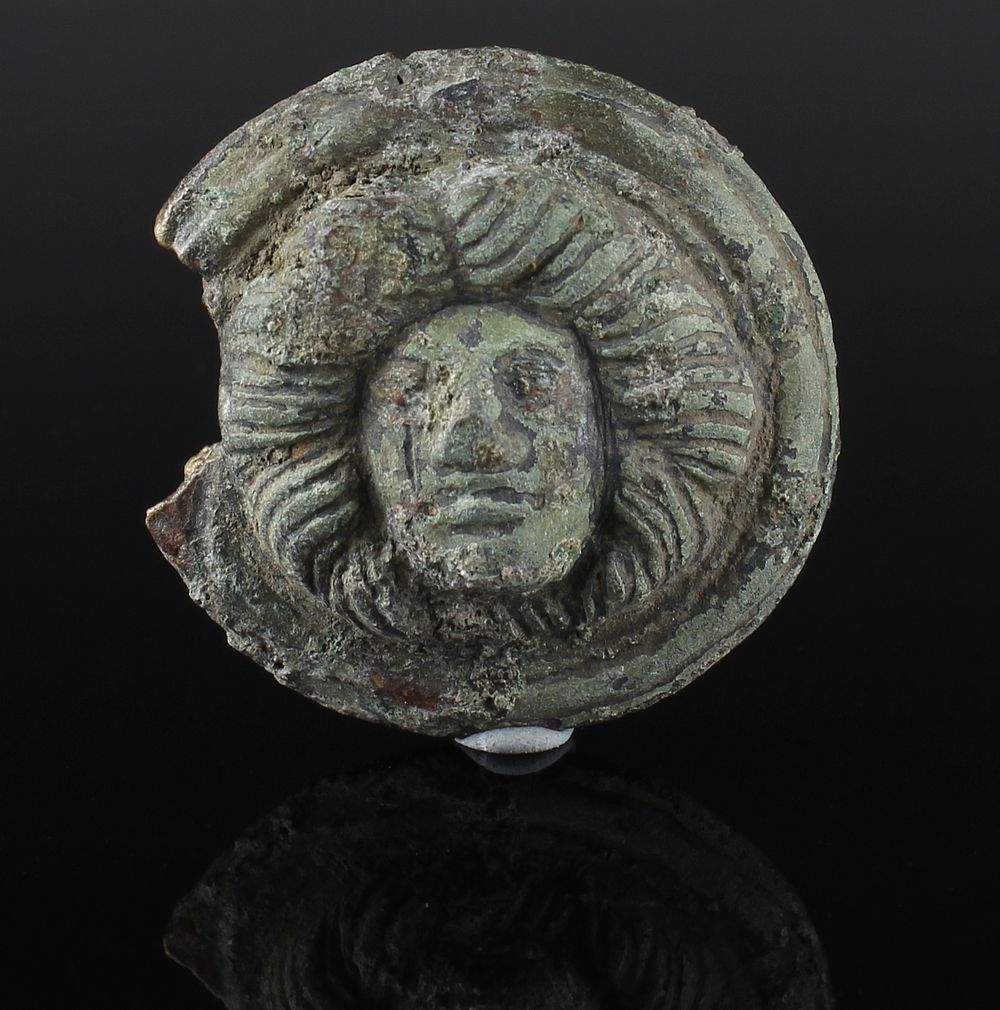
Subasta Bidspirit | Roman roundel with the head
Roman roundel with the head of Medusa - ITEM: Roundel with the head of Medusa MATERIAL: Bronze CULTURE: Roman PERIOD: 1st - 3rd Century A.D DIMENSIONS: 47 mm diameter CONDITION: Good condition PROVENANCE: Ex Dutch private collection, acquired between 1980 - 1990 Comes with Certificate of Authenticity and Export Licence. If you are from outside the European Union, we will have to apply for the export licence again for your country, this takes 3 to 5 weeks and has a cost of 5% of the hammer price, this amount will be added to the final invoice. The Roman depiction of Medusa, a figure from Greek mythology, was an enduring and significant image in Roman art, especially in the context of both mythology and protective symbolism. Medusa, one of the three Gorgons, was famously transformed into a monster with snakes for hair and the power to turn anyone who gazed upon her into stone. While the mythological story of Medusa’s transformation and her eventual slaying by the hero Perseus originates in Greek mythology, the Romans adopted and adapted the image of Medusa in a variety of artistic forms. Medusa was often portrayed with a striking, menacing face, her hair a tangle of snakes, symbolizing both her power and her curse. In Roman art, Medusa's image was often used in decorative works, such as reliefs, mosaics, and especially on bronze and marble sculptures. One of the most famous representations of Medusa in Roman art is the Gorgon’s head, which was frequently featured as an apotropaic symbol, used to ward off evil and protect spaces. This ”evil eye” function, associated with Medusa, was a significant part of Roman belief, as the face of Medusa was thought to have protective qualities when placed on items like shields, doorways, and public buildings. This use of her image as a protective charm highlights how Roman interpretations of mythology often merged with practical concerns about health, safety, and the unseen dangers of the world. Medusa also appeared in Roman portraiture, particularly in the form of large, dramatic representations of her head as a motif, often seen on coins and jewelry. Roman emperors, such as those during the Julio-Claudian dynasty, used Medusa's image to convey a sense of power, control, and protection, integrating the Gorgon into imperial propaganda. For example, the emperor Nero sometimes had coins minted with Medusa’s head, likely to symbolize the ruler’s connection to divine or supernatural protection. The dual nature of Medusa—both a symbol of danger and a protector—mirrors the complexities of Roman imperial power, where rulers needed to balance fear and reverence in their image.