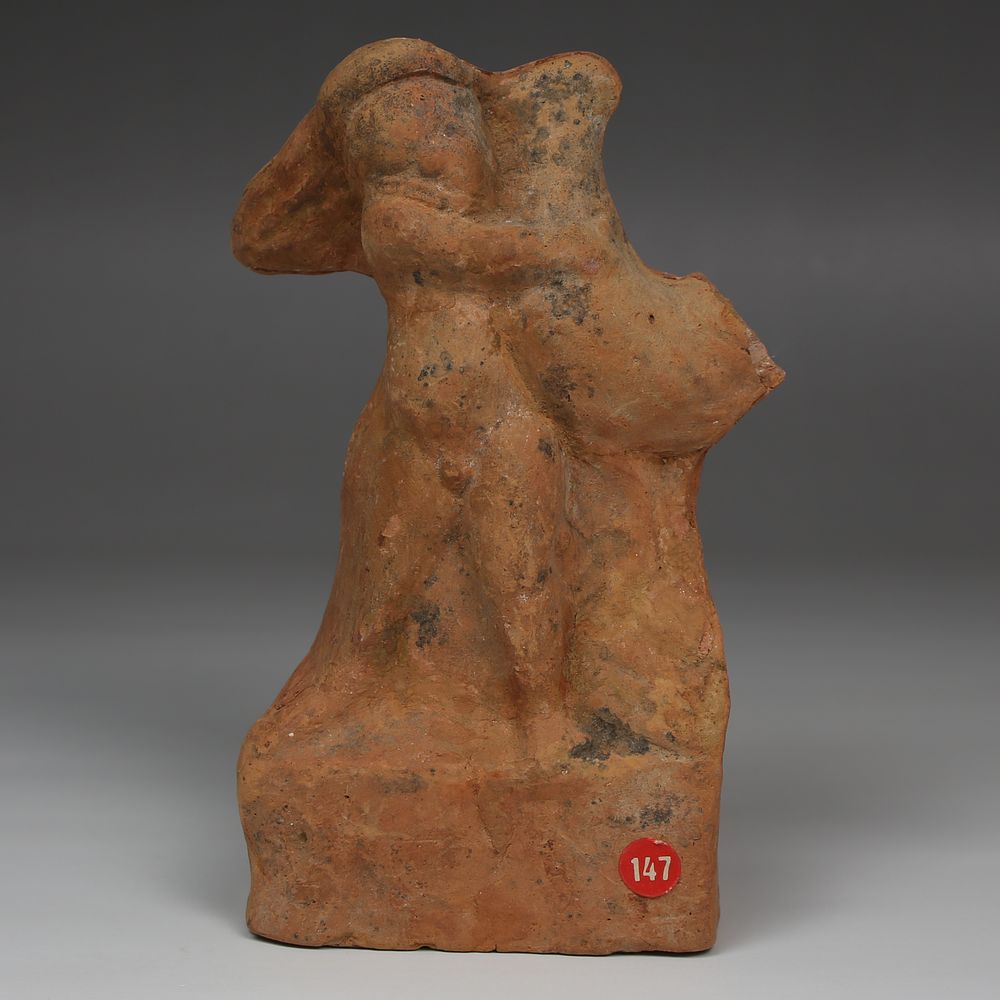
Subasta Bidspirit | Greek statuette of Eros with
Greek statuette of Eros with rooster - ITEM: Statuette of Eros with rooster MATERIAL: Pottery CULTURE: Greek, Hellenistic period PERIOD: 3rd - 1st Century B.C DIMENSIONS: 125 mm x 73 mm CONDITION: Good condition, the rooster has a missing part PROVENANCE: Ex French private collection, acquired between 1990 - 2000 Comes with Certificate of Authenticity and Export Licence. If you are from outside the European Union, we will have to apply for the export licence again for your country, this takes 3 to 5 weeks and has a cost of 5% of the hammer price, this amount will be added to the final invoice. The Eros with Rooster figure from the Hellenistic period is a fascinating representation of the god of love, Eros, combined with the imagery of a rooster, symbolizing various cultural and mythological meanings. Eros, typically depicted as a winged youth or child in Greek art, embodies love, desire, and attraction. During the Hellenistic period (c. 323–31 BCE), Eros was often portrayed in playful and intimate scenes, emphasizing the lighter, more personal aspects of love. In the Eros with Rooster figures, this depiction is coupled with the rooster, which held its own symbolic significance, especially as a symbol of virility and fertility in ancient Greek culture. The rooster, commonly associated with dawn and the renewal of life, also symbolized male potency and was often linked to erotic themes. Its appearance alongside Eros in these figurines may represent a celebration of fertility, sexual vitality, and the life-giving power of love. In some cases, the rooster could also serve as a gift associated with romantic or erotic relationships, as it was sometimes given to young men in courtship or as a part of coming-of-age rituals. The combination of Eros and the rooster in these figures likely underscores themes of passion and sexual awakening, blending the divine aspects of love with earthly, physical desire. These Eros with Rooster statuettes were typically made from terracotta, bronze, or marble and were often found in domestic settings, sanctuaries, or as grave offerings. They likely served both decorative and votive purposes, illustrating the personal nature of Hellenistic religion and its focus on intimate, human experiences. The playful nature of the figures reflects the broader artistic trends of the Hellenistic period, where art became more focused on realism, emotion, and daily life. By combining Eros with the rooster, these figurines encapsulate the Hellenistic fascination with love’s many dimensions—ranging from spiritual affection to physical desire—and serve as a testament to the era’s rich symbolic language.