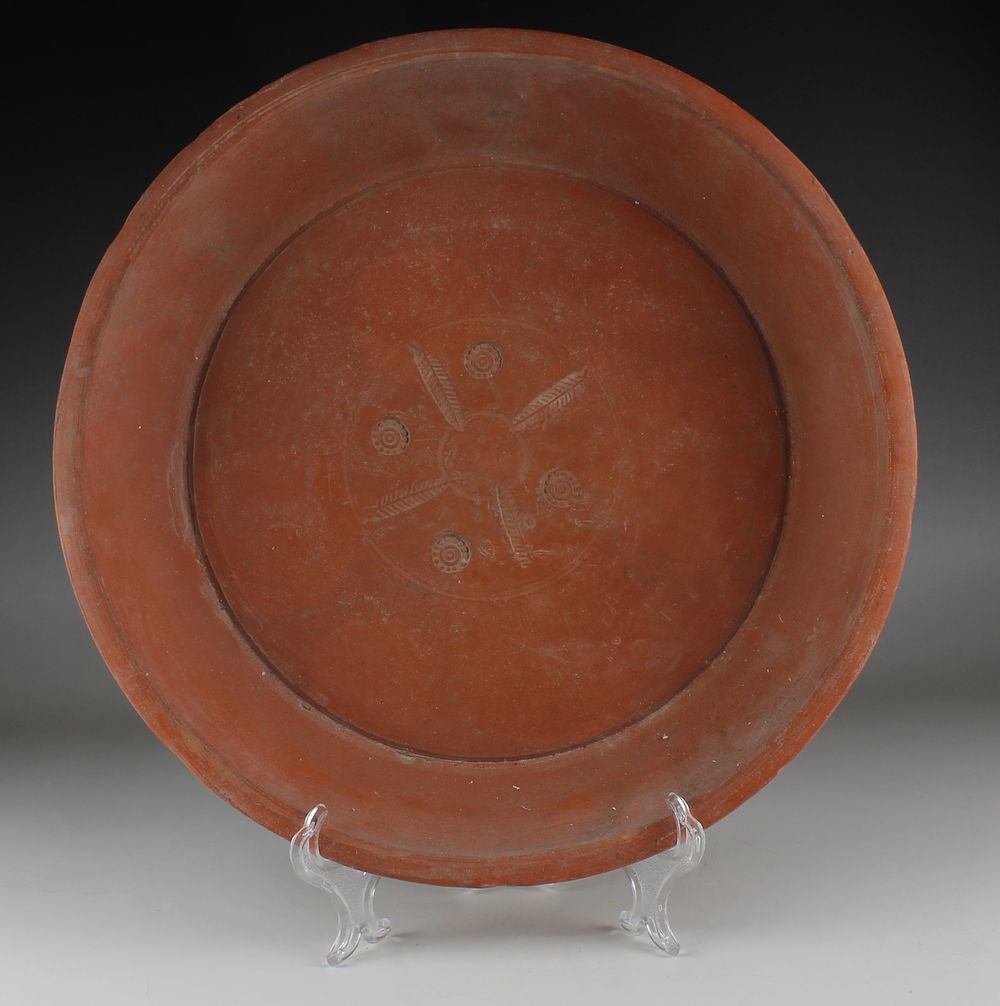
Subasta Bidspirit | Roman plate with decoration, Ex
Roman plate with decoration, Ex Marius-Victor-Ernest Dumas collection - ITEM: Plate with decoration MATERIAL: Pottery CULTURE: Roman PERIOD: 4th Century A.D DIMENSIONS: 49 mm x 290 mm diameter CONDITION: Good condition PROVENANCE: Ex Marius-Victor-Ernest Dumas private collection (North Africa and France), acquired in Tunisia between 1890 - 1920. M. Dumas was Controleur Civile (French colonial administrator) of the city of Sousse in Tunisia prior to World War I. This collection of Roman and North African antiquities has remained in the family for the past 100 years in the Haute-Savoie region of France. Comes with Certificate of Authenticity and Export Licence. If you are from outside the European Union, we will have to apply for the export licence again for your country, this takes 3 to 5 weeks and has a cost of 5% of the hammer price, this amount will be added to the final invoice. Roman vessels from North Africa, particularly those made during the height of the Roman Empire, reflect the region's significant role in the Roman economy and its thriving ceramic production. North Africa, especially modern-day Tunisia and Libya, became an important center for pottery production, known for producing fine tableware, storage vessels, and amphorae. One of the most notable types of pottery from this region is African Red Slip ware, a type of fine, red-gloss pottery that was highly valued across the Roman world. These vessels were used for serving and dining, prized for their high-quality craftsmanship and often adorned with stamped or molded decorations, including figures, animals, and geometric motifs. The export of North African pottery to various parts of the Roman Empire, from Italy to Britain, highlights the region’s importance in trade and the widespread demand for its products. Amphorae from North Africa, typically used for storing and transporting goods like olive oil and wine, are often found in archaeological contexts far from their place of origin, showing the extensive trade networks that connected the empire. The standardization and durability of these vessels made them ideal for shipping agricultural products, particularly olive oil, which was one of North Africa’s primary exports to Rome and other regions. This trade contributed to the economic prosperity of the region during the Roman period. In addition to their economic role, the design and style of Roman vessels from North Africa reveal much about the cultural exchanges between Roman and local traditions. While the shapes and forms of the vessels often adhered to Roman standards, the decorations and motifs sometimes incorporated local North African influences, reflecting a blend of Roman and indigenous artistic traditions.