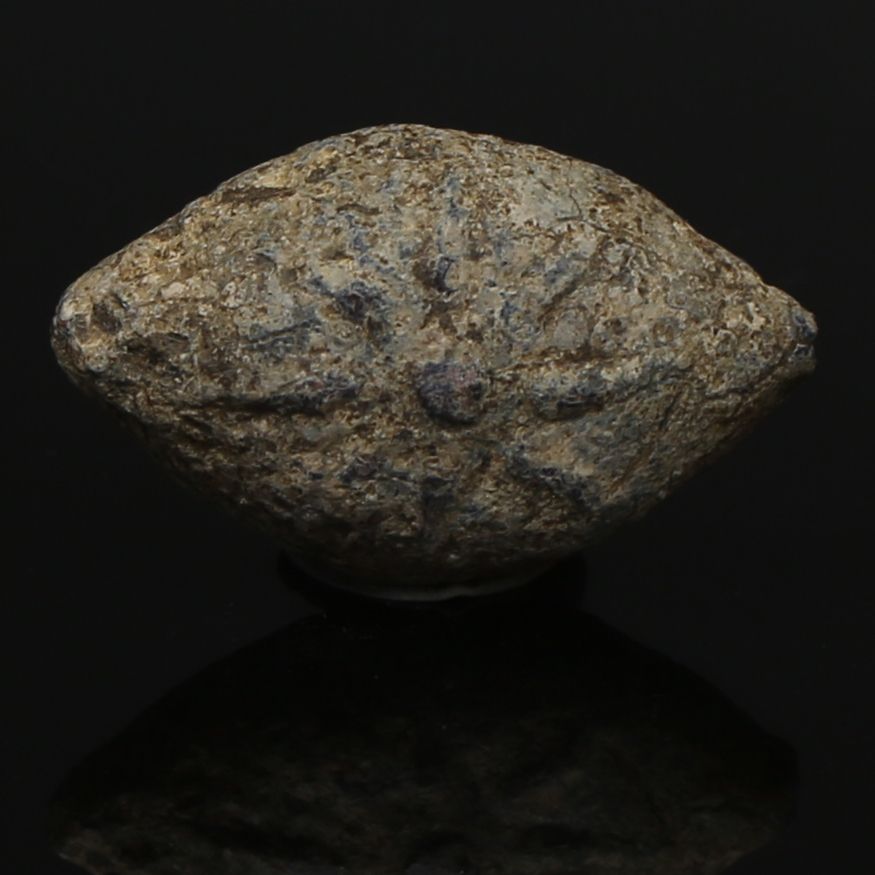
Subasta Bidspirit | Greek sling bullet with symbol
Greek sling bullet with symbol eight-ray star - ITEM: Sling bullet with symbol eight-ray star MATERIAL: Lead CULTURE: Greek PERIOD: 4th Century B.C DIMENSIONS: 16 mm x 30 mm CONDITION: Good condition PROVENANCE: Ex Dutch private collection, acquired between 1970 - 1990 PARALLEL: MANOV, M. & TORBOV, N., Inscribed Lead Sling Bullets with the Name of Alexander the Great and with Other Names and Symbols Found in Thrace, Archaeologia Bulgarica XX, 2 (2016), 29-43, P.38, Fig. 14 FREEMAN, P.W.M., POLLAND, A., Fields of Conflict: Progress and Prospect in Battlefield Archaeology, BAR International Series 958 (2001), p.14, Catalogue no. 2224 Comes with Certificate of Authenticity and Export Licence. If you are from outside the European Union, we will have to apply for the export licence again for your country, this takes 3 to 5 weeks and has a cost of 5% of the hammer price, this amount will be added to the final invoice. Sling, implement for propelling missiles, one of the first missile weapons used in warfare. It consisted of a small strap or socket of leather to which two cords were attached. The warrior, or slinger, held the ends of the cords in one hand, placed the missile snugly in the strap, and whirled the socket and missile rapidly around his head; by letting go of one cord at the right moment, the slinger could let the missile fly out of the socket at a high speed. In the Roman army of the time of the Punic Wars (3rd–2nd century BC), the slingers were auxiliaries from Greece, Syria, and Africa. The Balearic islanders who constituted a part of Hannibal’s Carthaginian army fighting the Romans were renowned as slingers.