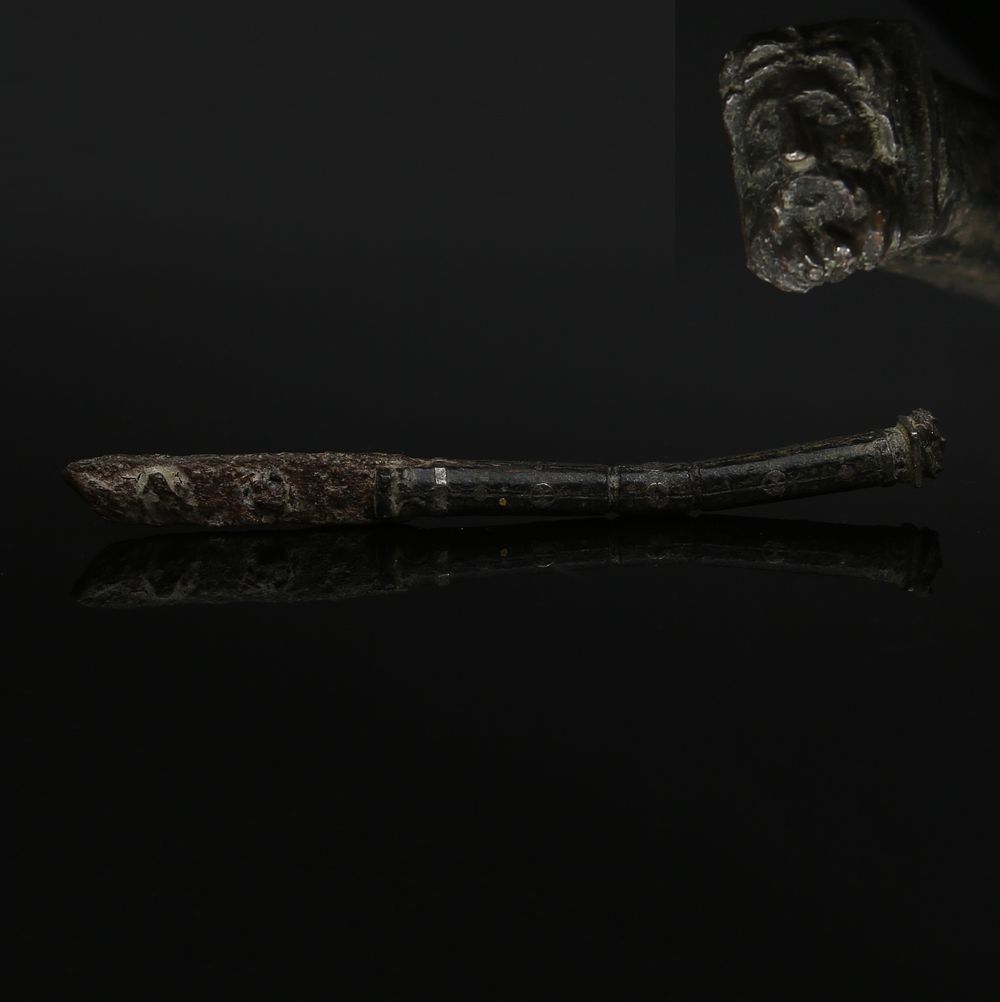
Subasta Bidspirit | Roman knife with silver inlay
Roman knife with silver inlay and Jupiter head - ITEM: Knife with silver inlay and Jupiter head MATERIAL: Bronze and silver CULTURE: Roman PERIOD: 1st Century B.C - 1st Century A.D DIMENSIONS: 100 mm x 8 mm CONDITION: Good condition PROVENANCE: Ex Spanish private collection, bought in English auction house. Ex English private collection, acquired between 1965 - 1975 Comes with Certificate of Authenticity and Export Licence. If you are from outside the European Union, we will have to apply for the export licence again for your country, this takes 3 to 5 weeks and has a cost of 5% of the hammer price, this amount will be added to the final invoice. Roman Jupiter, known as Jupiter in Latin and Jupiter Optimus Maximus, was the chief deity in the Roman pantheon and played a central role in the religious and political life of ancient Rome. As the king of the gods, Jupiter was associated with the sky, thunder, and lightning, and he was considered the protector of the state and its laws. His role was analogous to that of Zeus in Greek mythology, from whom many of his attributes and myths were borrowed. Jupiter's position as the supreme deity meant that he was venerated in numerous temples and had a significant influence on Roman rituals and public ceremonies. One of the most prominent symbols of Jupiter was the thunderbolt, which he wielded as a weapon to maintain order and enforce justice. His primary temple, the Temple of Jupiter Optimus Maximus on the Capitoline Hill in Rome, was the most important religious site in the city. This grand temple, completed in 509 BCE and rebuilt several times, served as a focal point for state rituals and ceremonies. Jupiter was honored with grand festivals such as the Ludi Romani, which celebrated his role as the guardian of Rome and the Roman people. These public ceremonies were central to the Roman state religion, reinforcing Jupiter's significance in maintaining the stability and success of the empire. Jupiter's influence extended beyond religious practices into the realm of politics and imperial ideology. Roman emperors often associated themselves with Jupiter to legitimize their rule and connect their reigns with divine authority. This connection was particularly evident in the adoption of titles and symbols associated with Jupiter, which were used to convey the emperor's role as a protector and ruler sanctioned by the gods.