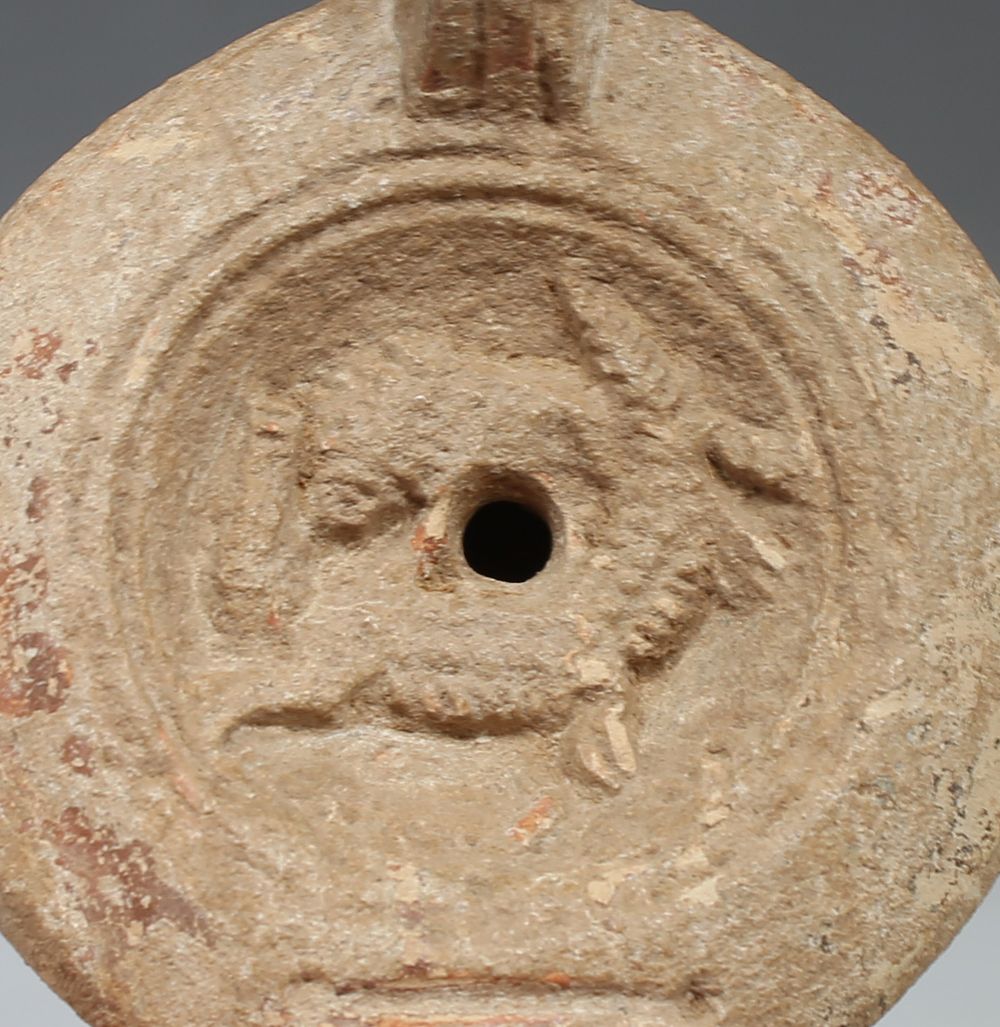
Subasta Bidspirit | Roman factory oil lamp depicting
Roman factory oil lamp depicting a lion and a crocodile with makers mark, Type Bussièree D II 1 - ITEM: Factory oil lamp depicting a lion and a crocodile with makers mark, Type Bussièree D II 1 MATERIAL: Pottery CULTURE: Roman PERIOD: 1st - 3rd Century A.D DIMENSIONS: 38 mm x 72 mm x 102 mm CONDITION: Good condition PROVENANCE: Ex Swedish private collection, bought in the 1970s and inherited there by the present owner PARALLEL: Getty Museum Inventory no. 83.AQ.377.137 Comes with Certificate of Authenticity and Export Licence. If you are from outside the European Union, we will have to apply for the export licence again for your country, this takes 3 to 5 weeks and has a cost of 5% of the hammer price, this amount will be added to the final invoice. Roman oil lamps were essential household items in the ancient Roman world, used for illumination in homes, temples, and public spaces. These lamps were typically made from clay, though bronze and other metals were also used. The basic design of a Roman oil lamp included a reservoir to hold oil, usually olive oil, and a wick that protruded from a nozzle or spout. When lit, the wick would draw the oil up and burn, providing a steady source of light. The compact and efficient design of these lamps made them a practical solution for lighting needs throughout the Roman Empire. The decoration and motifs on Roman oil lamps are diverse and reflect a wide range of cultural and artistic influences. Lamps often featured intricate designs, including geometric patterns, mythological scenes, animals, and everyday life depictions. Some lamps were molded with figures of gods and goddesses, such as Venus, Hercules, or Minerva, while others showcased scenes from popular myths or gladiatorial combat. These decorative elements not only added aesthetic value but also held symbolic meanings, possibly invoking protection, good fortune, or divine favor. The wide variety of designs and the spread of Roman oil lamps across different regions also highlight the extent of cultural exchange and influence within the Roman Empire. In addition to their practical use for lighting, Roman oil lamps also played roles in religious and funerary contexts. They were commonly used in domestic religious practices, such as household shrines (lararia), where lamps would be lit as offerings to household gods. In funerary practices, oil lamps were often placed in tombs and graves, symbolizing the light that would guide the deceased in the afterlife.