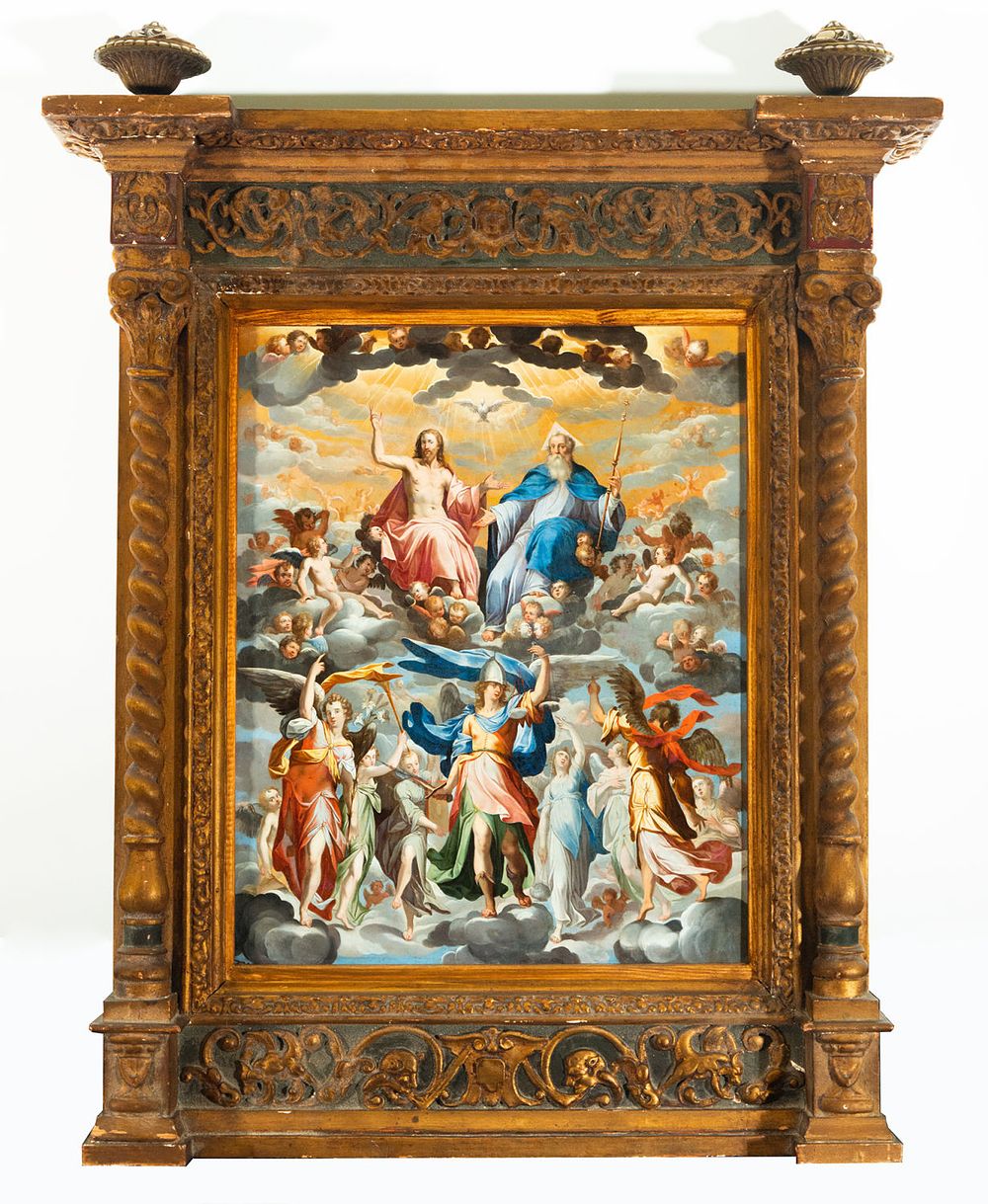
Bidspirit auction | Archangel Saint Michael Surrounded by
Archangel Saint Michael Surrounded by Angels in front of God the Father, Jesus Christ and the Holy Spirit, in the manner of Bernardo Bitti, Peruvian colonial work, 17th century - Oil on copper, framed measures: 84 x 63, copper measures: 48 x 38 cm. The magnificent representation before which we find ourselves follows the canons of the most exquisite colonial refinement that, in turn, drinks from the currents of the Italian Renaissance, only Italian painter Bernardo Bitti who came to the Viceroyalty of Peru, in which we observe a great influence of painters like El Greco. Bernardo Bitti, Jesuit curate brother and Italian painter who developed his work in Lima, Cusco, Juli, Ayacucho, La Paz and Sucre. The Spanish and, in general, European contribution to the Cuzco School of painting occurred from a very early period, when the construction of the cathedral began. Bernardo Bitti arrives in Peru on May 31, 1575 to ”evangelize through art”, at the request of the Provincial of the Society of Jesus, Father Bracamonte. He worked in Lima from 1575, moving to Cusco in 1583 and then, in 1585, to Juliaca, Puno. A return to Cusco between 1595 and 1598 is documented, alternating his stay in the city, according to José de Mesa and Teresa Gisbert, with the cities of Chuquisaca and Arequipa even up to 1600. Reference is made to a new stay of Bitti in Arequipa around 1603 returning to Lima in 1604, the city where he would remain until his death in 1610. His great artistic talent made him the main and exclusive painter of the Jesuit order. He was a well-known painter and sculptor from South America during the 16th century. Although he never signed any of his paintings, his style has become unmistakable. Among the main characteristics of it we can highlight the predominant use of the line, the mere insinuation of the volumes, the elongated figure in the mannerist style, the sophistication in the posture of his characters, who are worked based on a serpentine line. Naturalism is not appreciated in Bitti's figures, but on the contrary, the weightlessness of his fabrics, his fanciful colors and the absence of different textures of his cloths (influenced by El Greco and Raphael according to the historians José de Mesa and Teresa Gisbert) they respond to a desire for idealization of their figures as can be seen in their Virgins and Saints who are wrapped in pastel-colored fabrics. Reference bibliography: Lavarello de Velaochaga, Gabriela ”Plastic Artists in Peru, XVI-XVII-XVIII-XIX-XX centuries” Lima, 2003, p. 47. who are worked based on a serpentine line. Naturalism is not appreciated in Bitti's figures, but on the contrary, the weightlessness of his fabrics, his fanciful colors and the absence of different textures of his cloths (influenced by El Greco and Raphael according to the historians José de Mesa and Teresa Gisbert) they respond to a desire for idealization of their figures as can be seen in their Virgins and Saints who are wrapped in pastel-colored fabrics. Reference bibliography: Lavarello de Velaochaga, Gabriela ”Plastic Artists in Peru, XVI-XVII-XVIII-XIX-XX centuries” Lima, 2003, p. 47. who are worked based on a serpentine line. Naturalism is not appreciated in Bitti's figures, but on the contrary, the weightlessness of his fabrics, his fanciful colors and the absence of different textures of his cloths (influenced by El Greco and Raphael according to the historians José de Mesa and Teresa Gisbert) they respond to a desire for idealization of their figures as can be seen in their Virgins and Saints who are wrapped in pastel-colored fabrics. Reference bibliography: Lavarello de Velaochaga, Gabriela ”Plastic Artists in Peru, XVI-XVII-XVIII-XIX-XX centuries” Lima, 2003, p. 47. its fanciful colors and the absence of different textures of its cloths (influenced by El Greco and Raphael according to the historians José de Mesa and Teresa Gisbert) respond to a desire for idealization of their figures as can be seen in their Virgins and Saints who are wrapped in pastel colored fabrics. Reference bibliography: Lavarello de Velaochaga, Gabriela ”Plastic Artists in Peru, XVI-XVII-XVIII-XIX-XX centuries” Lima, 2003, p. 47. its fanciful colors and the absence of different textures of its cloths (influenced by El Greco and Raphael according to the historians José de Mesa and Teresa Gisbert) respond to a desire for idealization of their figures as can be seen in their Virgins and Saints who are wrapped in pastel colored fabrics. Reference bibliography: Lavarello de Velaochaga, Gabriela ”Plastic Artists in Peru, XVI-XVII-XVIII-XIX-XX centuries” Lima, 2003, p. 47.