Bidspirit auction | ARGENSON RENÉ LOUIS DE VOYER
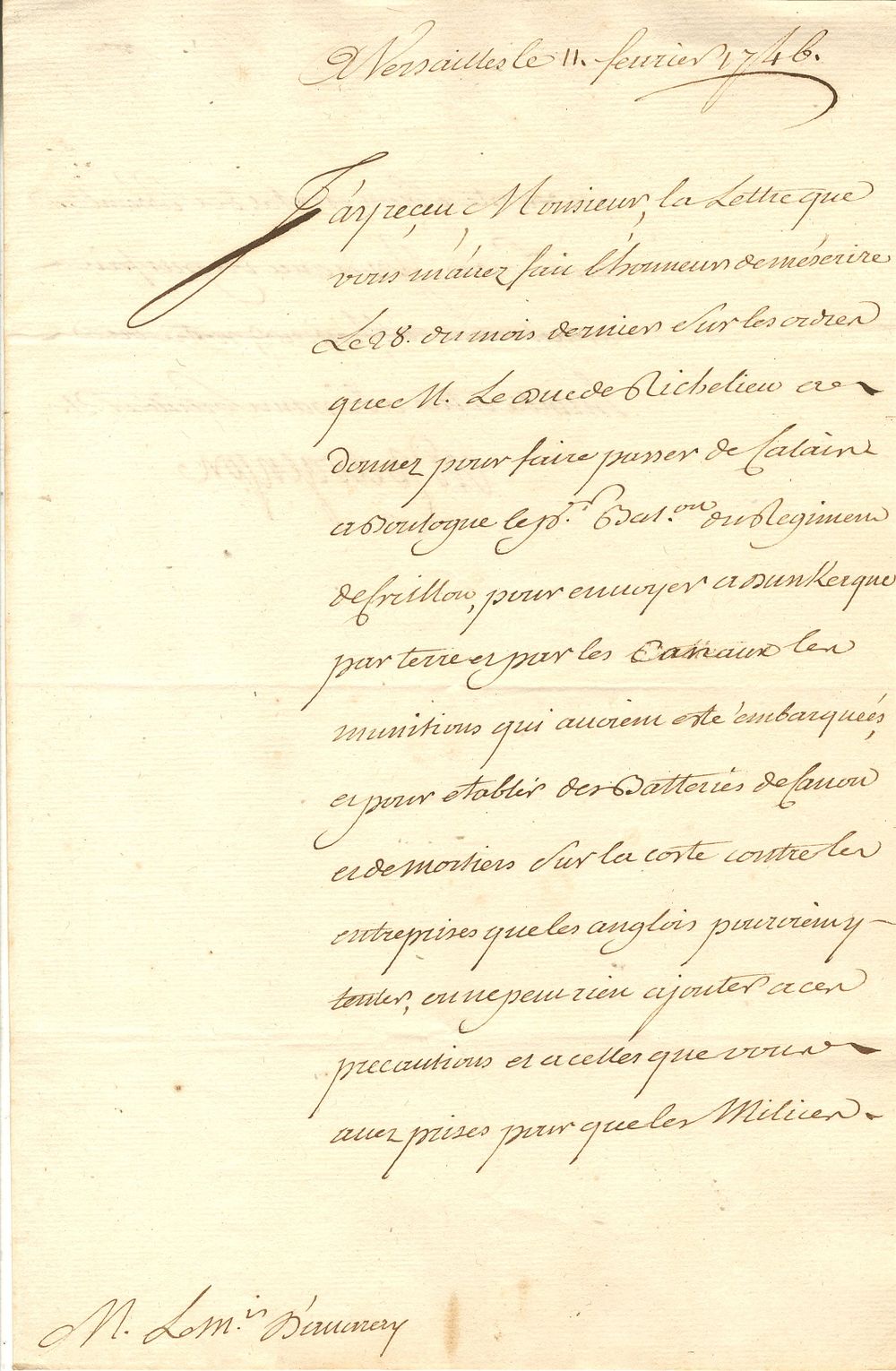
ARGENSON RENÉ LOUIS DE VOYER DE PAULMY, MARQUIS D': (1694-1757) - ARGENSON RENÉ LOUIS DE VOYER DE PAULMY, MARQUIS D': (1694-1757) French statesman, diplomat and writer. A friend and former schoolfellow of Voltaire, d'Argenson served as Secretary of State for Foreign Affairs under Louis XV from 1744-47, during the War of the Austrian Succession, and was present with the King at the French victory at Fontenoy in 1745. An influential political thinker and advocate of enlightened government, he was also the author of extensive Mémoires and a remarkable journal chronicling the political and social life of eighteenth-century France. L.S., M d´Argenson , two pages, folio, Versailles, 11th February 1746, to Marquis Charles-Théophile de Besiade d’Avaray, in French. D´Argenson´s letter concerns the orders issued by the Duke of Richelieu to transfer the first battalion of the Crillon Regiment from Calais to Boulogne in order to send to Dunkirk ´....par terre et par les canaux les munitions qui avoient esté embarquées et pour établir des batteries de canon et de mortiers sur la coste contre les entreprises que les Anglois pourroient y tenter… précautions… prises pour que les milices gardes coste soient en état de s’assembler au premier ordre…´ (Translation: ´… by land and via the canals, the munitions that had been loaded onto ships, and to establish batteries of cannons and mortars along the coast against any operations the English might attempt there… precautions…taken to ensure that the coastal militia are in a position to assemble at the first order…´ ). With blank integral leaf. VG Charles-Théophile de Béziade, Marquis d’Avaray (1701-1746) French soldier who served as a maréchal de camp in the armies of Louis XV. A veteran of campaigns associated with the War of the Polish Succession and the French intervention in Corsica, he subsequently served during the War of the Austrian Succession, including in Flanders. D’Avaray died of smallpox at Antwerp on 3rd May 1746, less than three months after the present letter. The present letter was written during the War of the Austrian Succession (1740-48), at a time when Britain and France were engaged in open hostilities and the French government was contemplating an invasion of Britain in support of the Jacobite cause. In February 1746 preparations were underway around Dunkirk, Calais and Boulogne for the movement of troops and military supplies, while the Channel coast required protection against possible British attack. D’Argenson's instructions concerning the transfer of the Crillon regiment, the movement of munitions to Dunkirk and the establishment of coastal artillery batteries provide a revealing glimpse of these extensive military preparations.