Bidspirit auction | PASTEUR LOUIS: (1822-1895)
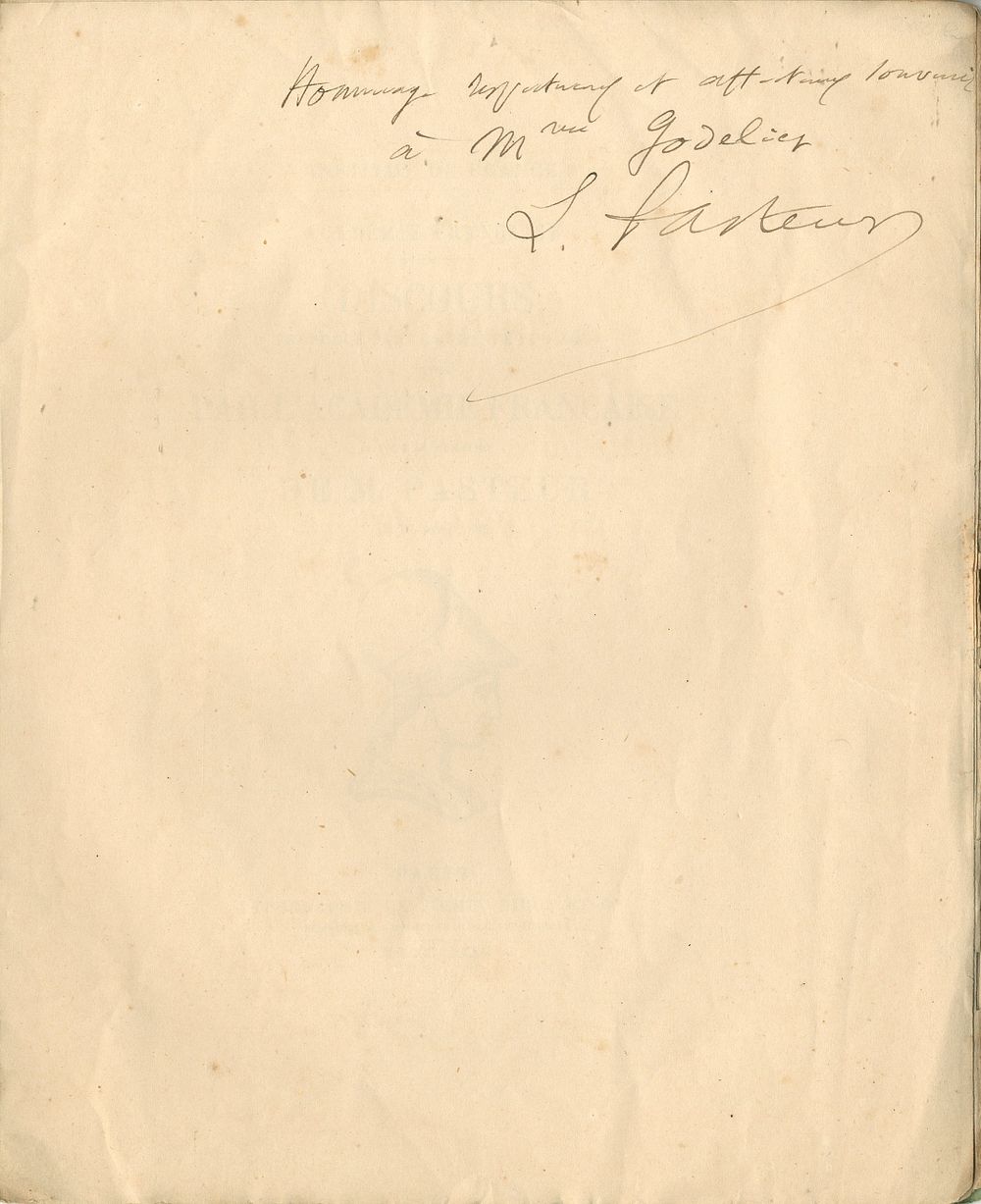
PASTEUR LOUIS: (1822-1895) - PASTEUR LOUIS: (1822-1895) French chemist and microbiologist, renowned for his discoveries of the principles of vaccination and pasteurisation. A printed 4to copy of the Discours prononcé dans la Séance Publique tenue par L´Académie Française pour la réception de M. Pasteur ( ´Speech delivered at the public sitting held by the Académie Française to welcome Mr Pasteur´ ) on 27th April 1882, published on behalf of the Institut de France by Firmin-Didot et Cie., Paris, 1882. Signed and inscribed by Pasteur with a large signature to the front free endpaper, ´Hommage respectueux souvenir à Mme. Godélier, L. Pasteur´ . The present copy, comprising 23 pages which are unopened at the top edge and bound in the original green and black printed paper wrappers, does not include the Réponse of Ernest Renan. Some light overall age wear and with some staining and fraying to the edges of the wrappers, G The present copy of Pasteur´s address is inscribed to the wife of the French military surgeon Charles Godélier (1813-1877). Together, the Godélier´s were among the closest personal confidants, medical caretakers, and lifelong friends of Pasteur and his wife, Marie. Pasteur was elected to the Académie française on 8th December 1881, succeeding the celebrated lexicographer and philosopher Émile Littré, and was formally received on 27th April 1882. His election was widely regarded as a landmark in the history of the Academy, reflecting the growing recognition of scientific achievement alongside literature and the humanities within French intellectual life. In his Discours de réception, Pasteur modestly attributed the honour not to himself but to science, declaring that the distinction conferred upon him belonged to scientific endeavour as a whole. He paid generous tribute to Littré's monumental scholarship while arguing that the discoveries of modern science had become one of the principal forces shaping civilisation. The address also reflected Pasteur's long-held conviction that scientific inquiry and religious faith were fundamentally compatible. The official reply was delivered by the writer and historian Ernest Renan, who praised Pasteur as one of the foremost benefactors of humanity. Acknowledging that the Academy was honouring not merely a distinguished scientist but a man whose discoveries had transformed medicine, agriculture, and industry, Renan welcomed Pasteur as evidence that the sciences and the humanities together formed the foundation of French intellectual culture. The speeches remain among the most celebrated discours de réception in the history of the Académie française and marked the public recognition of Pasteur at the height of his international reputation.