Bidspirit auction | RENOIR PIERRE-AUGUSTE: (1841-1919) Renoir writes
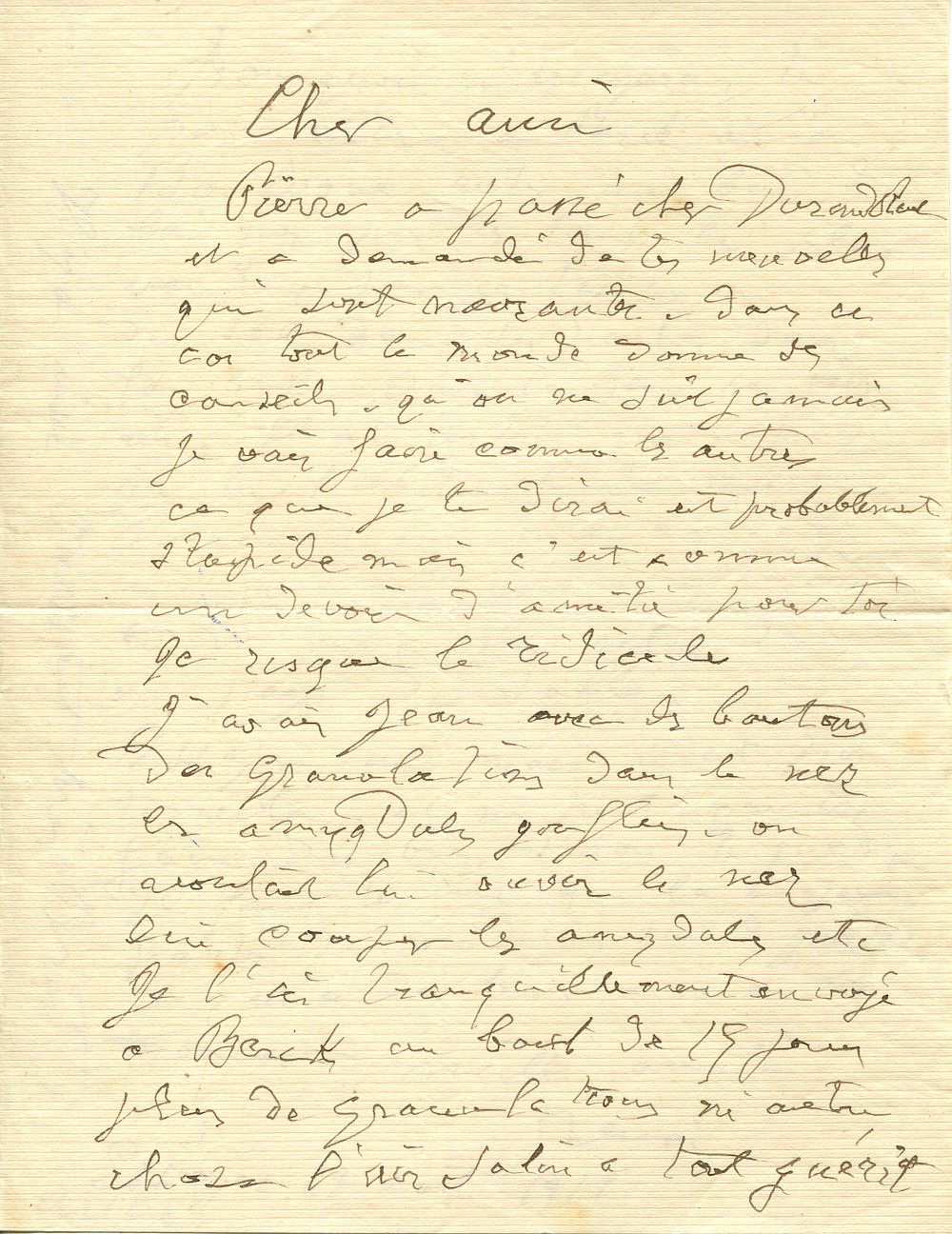
RENOIR PIERRE-AUGUSTE: (1841-1919) Renoir writes to Monet to offer his advice in the month after his friend had been diagnosed with cataracts - RENOIR PIERRE-AUGUSTE: (1841-1919) French Impressionist artist. A compassionate A.L.S., Renoir , two pages (written to the first and third sides of the bifolium), 8vo, Essoyes, 19th August 1912, to [Claude Monet] ( ´Cher ami´ ), in French. Renoir commences his letter by stating ´ Pierre a passé chez Durand-Ruel et a demandé de tes nouvelles qui sont navrantes´ (Translation: ´ Pierre dropped by Durand-Ruel’s and asked after you; the news is distressing´ ) and continues in a gently philosophical vein ´ Dans ce cas tout le monde donne des conseils, qu'on ne suit jamais. Je vais faire comme les autres. Ce que je dirai est probablement stupide mais c'est comme un devoir d'amitié pour toi. Je risque le ridicule´ (Translation: ´I n such cases, everyone offers advice, which is never followed. I shall do as others do. What I am about to say is probably foolish, but I feel it is my duty as a friend to you. I risk looking ridiculous´ ), before offering his unsolicited advice, ´ J'avais Jean avec des boutons, des granulations dans le nez, des amygdales gonflées. On voulait lui ouvrir le nez, lui couper les amygdales etc. Je l'ai tranquillement envoyé à Berck, au bout de 15 jours plus de granulations ni autre chose, l'air salin à tout guérit. Pourquoi n'essayerais tu pas aller à Berck où à Boulogne rester au bord de mer par les temps les plus venteux. Par ces temps on a du sel dans ses poches, dans la barbe dans les yeux le nez, etc. Il est certain que le pays que tu habites et ta maison légèrement en contrebas sont propices à ce genre d'affection. Tu n'auras pas cela dans un pays de sable´ (Translation: ´J ean had spots, granulations in his nose and swollen tonsils. They wanted to operate on his nose, remove his tonsils, and so on. I quietly sent him to Berck; after a fortnight, the granulations and everything else had gone – the sea air cured it all. Why don’t you try going to Berck or Boulogne and staying by the seaside when the weather is at its windiest? At times like these, you’ve got salt in your pockets, in your beard, in your eyes and nose, and so on. It’s certain that the area where you live and your house, which is situated slightly below the surrounding ground level, are conducive to this sort of condition. You wouldn’t have that in a sandy region´ ). Renoir concludes his letter by writing ´ Essayer un mois n'est pas terrible, et ne peut que te faire du bien sinon te guérir. Il faut te dire que la majeure partie des médecins sont des gourdes. Il y en a des bons mais où les trouver´ (Translation: ´ Trying it for a month isn’t a bad idea, and can only do you good, if not cure you. I must tell you that most doctors are fools. There are some good ones, but where are they to be found?´ ). A letter of touching content and excellent association. VG Claude Monet (1840-1926) French Impressionist painter. The artist had been diagnosed with cataracts in July 1912, a month prior to receiving the present letter, after visiting a specialist in Paris. The doctor noted that the condition was not yet advanced enough for surgery and prescribed a conservative treatment regimen—including specialised eyedrops—to slow down the clouding process. This initial diagnosis terrified Monet, prompting him to stubbornly avoid any surgical intervention for the next eleven years until he had almost completely lost his vision. Renoir mentions his two eldest sons in the present letter; Pierre Renoir (1885-1952) who became a stage and film actor, and Jean Renoir (1894-1979) who became a noted film director.