Subasta Bidspirit | WRIGHT ORVILLE: (1871-1948) American Aviator
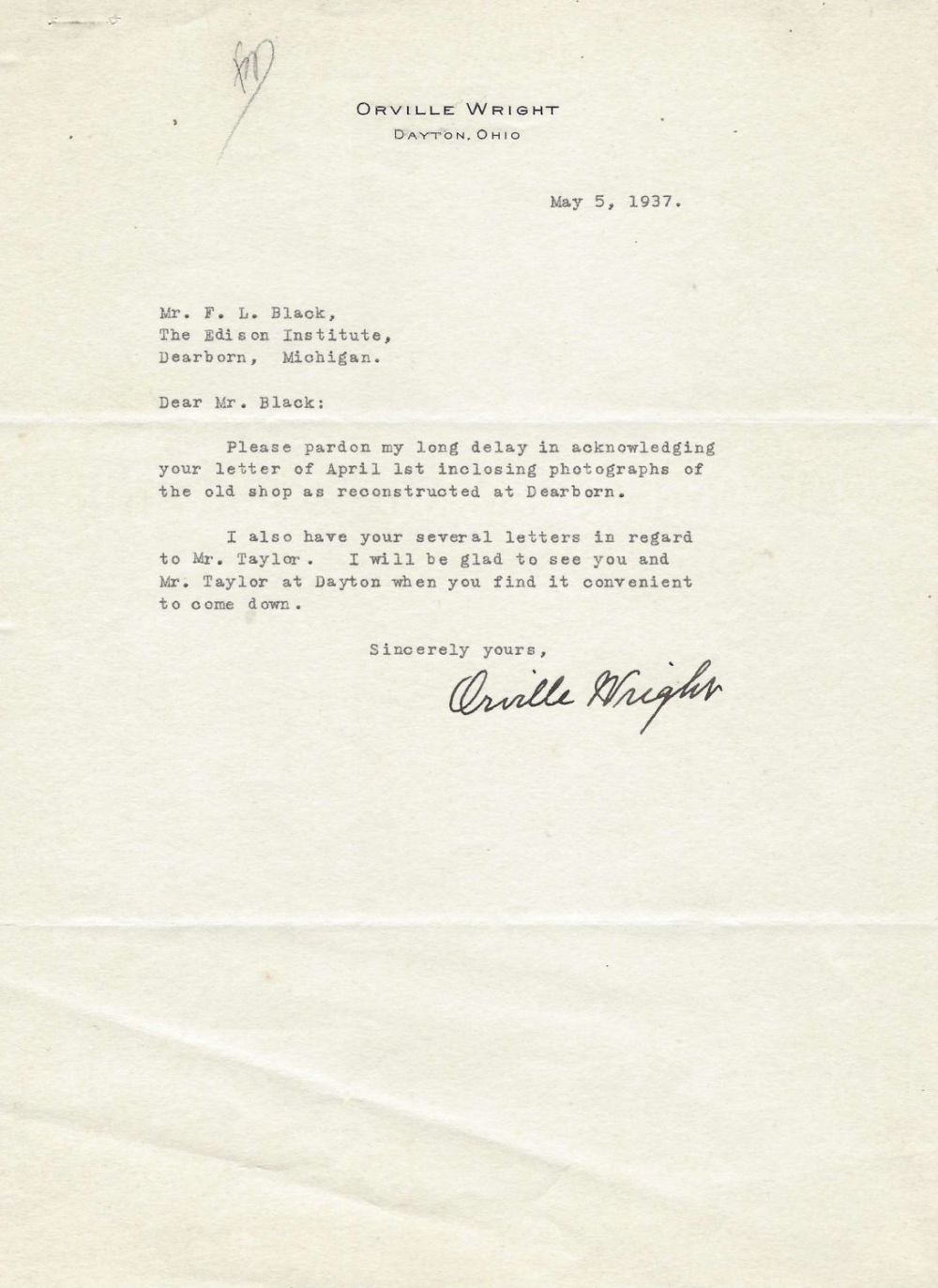
WRIGHT ORVILLE: (1871-1948) American Aviator who, with his brother Wilbur, invented and built the wo... - WRIGHT ORVILLE: (1871-1948) American Aviator who, with his brother Wilbur, invented and built the world's first successful airplane and made the first controlled, powered and sustained heavier-than-air human flight on 17th December 1903. T.L.S., Orville Wright, one page, 4to, Dayton, Ohio, 5th May 1937, to F. L. Black of The Edison Institute in Dearborn, Michigan. Wright apologises for the long delay in acknowledging his correspondent's letter and 'photographs of the old shop as reconstructed at Dearborn' and states that he has received Black's letters concerning Mr. Taylor, remarking 'I will be glad to see you and Mr. Taylor at Dayton when you find it convenient to come down.' Two small staple holes to the upper left corner and a couple of light creases to the lower third of the page, none of which affect the text or signature, otherwise VG £300-400 The Edison Institute, also known as The Henry Ford Museum of Innovation, is a large indoor and outdoor history museum complex situated in Dearborn, Michigan. The Institute was dedicated by American President Herbert Hoover to Ford's long-time friend Thomas Edison on 21st October 1929 (the 50th anniversary of the first successful incandescent light bulb) in a ceremony attended by Marie Curie, George Eastman, John D. Rockefeller, Will Rogers and Orville Wright amongst others. The museum includes Edison's Laboratory and the Wright Brother's bicycle shop, which Orville Wright refers to in the present letter. In the early stages of the Institute's existence many considered the acquisitions as flea market fodder, although they are now clearly regarded as well-preserved priceless relics. The Wright Brothers bicycle shop in Dayton was purchased in 1936 and, having been carefully dismantled, Orville Wright helped supervise the building's reconstruction and restoration. The bicycle shop that the Wright Brothers operated and managed owes much to the history of aviation as it not only helped them finance their invention of the airplane but, as excellent mechanics, the skills they developed in bicycle repairs also assisted them in designing the aircraft they used to make man's first powered flight on 17th December 1903.