Bidspirit auction | MATISSE HENRI: (1869-1954)
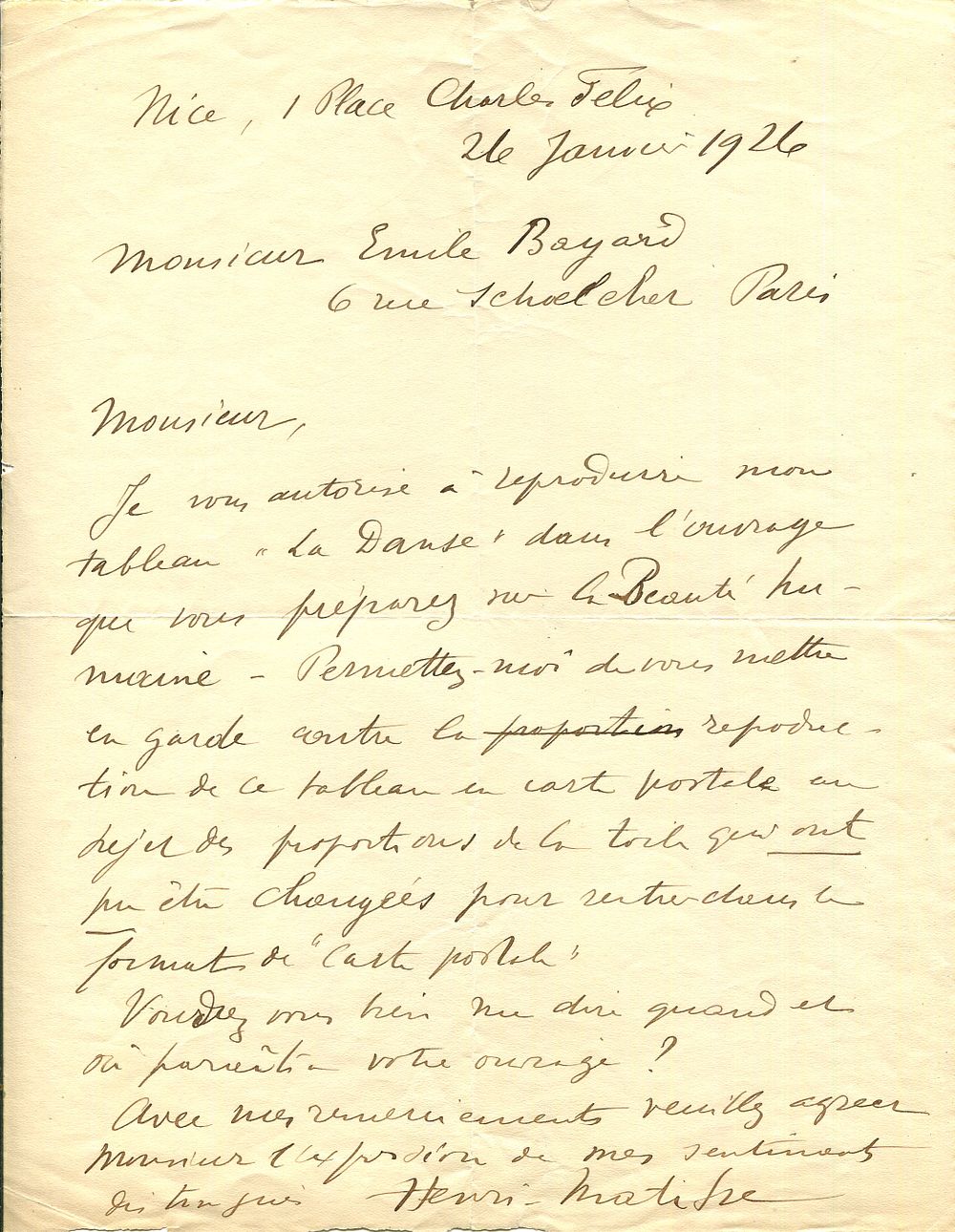
MATISSE HENRI: (1869-1954) - MATISSE HENRI: (1869-1954) French artist. A good A.L.S., Henri Matisse , one page, 4to, Place Charles Felix, Nice, 26th January 1926, to Emile Bayard, in French. Matisse states ´Je vous autorise à reproduire mon tableau ”La Danse” dans l´ouvrage que vous préparez sur la Beauté humaine´ (Translation: ´I grant you permission to reproduce my painting “La Danse” in the book you are preparing on human beauty´ ), although continues ´Permettez-moi de vous mettre en garde contre la reproduction de le tableau en carte postale au sujet des proportions de la toile qui ont pu être changées pour rentrer dans le format de ”carte postale”´ (Translation: ´Please allow me to caution you against reproducing the painting from a postcard, as the proportions of the canvas may have been altered to fit the “postcard” format´ ) and in concluding asks ´Voudrez vous bien me dire quand et où paraitra votre ouvrage?´ (Translation: ´Would you be so kind as to let me know when and where your book will be published?´ ). A letter of good content for its reference to one of the artist´s most famous works. Some very light, minor creasing. and with slightly irregular edges and a few small areas of paper loss, not affecting the text or signature, about VG Emile Bayard (1868–1937) French writer, art historian and editor of numerous illustrated works on the fine arts. His book L'Art de reconnaître la beauté du corps humain. L'Homme. La Femme. L'Enfant was published in Paris by Ernest Gründ in 1926. Conceived as a richly illustrated study of the human figure in art, the book contained approximately 150 illustrations reproducing works by artists from antiquity to the modern era. First exhibited at the Salon d'Automne in Paris in 1910, La Danse is widely regarded as one of Matisse's greatest masterpieces and one of the defining images of twentieth-century modern art. By the time of the present letter, the painting had already achieved international renown, and Matisse's warning against reproducing it from a postcard demonstrates the importance he attached to preserving the integrity of its composition and proportions.