Bidspirit auction | BORROMEO CHARLES: (1538-1584) Borromeo on
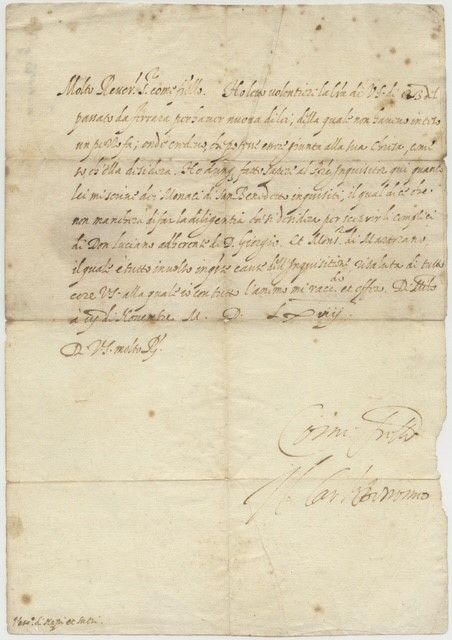
BORROMEO CHARLES: (1538-1584) Borromeo on the Roman Inquisition, the suppression of Heresy, and the enforcement of post-Tridentine orthodoxy - BORROMEO CHARLES: (1538-1584) Italian Cardinal of the Catholic Church who served as Archbishop of Milan 1564-84 and was a leading figure of the Counter-Reformation. Borromeo was canonized as a saint by Pope Paul V in 1610. A rare L.S., Il Car [dina] le Borromeo, with holograph subscription , one page, 4to, Milan, 3rd November 1568, to Camillo Campeggi, Bishop of Nepi and Sutri, and a former General Inquisitor, in Italian. Borromeo acknowledges having received news from Campeggi during his passage through Ferrara and confirms that Campeggi’s instructions have been transmitted to the local Inquisitor concerning an investigation into the Benedictine monks of San Benedetto at Montecassino, the mother house of the Benedictine Order. He insists that every diligence be employed to identify the accomplices of Don Luciano, a follower of the condemned heretic Giorgio Siculo, whose heterodox teachings continued to circulate clandestinely decades after his execution in 1551. The letter further references Girolamo Federici, Bishop of Martirano, praised for his unwavering commitment to the cause of the Inquisition. An exceptionally significant document from the height of Carlo Borromeo’s reforming authority, illuminating the practical mechanisms of the Roman Inquisition in the immediate aftermath of the Council of Trent. Written shortly after Campeggi’s elevation to the episcopate, the letter reflects the close coordination between episcopal and inquisitorial power that characterized the enforcement of Catholic orthodoxy in the late sixteenth century. With integral address leaf (lacking the lower half). Some light age wear and minor foxing, and with a couple of small, neat splits to the edges of folds, G Giorgio Siculo (Giorgio da Sicilia, c. 1517–1551) was an Italian religious dissenter associated with radical spiritual movements circulating in southern and central Italy during the mid-16th century. Influenced by apocalyptic and anti-institutional currents, he rejected key aspects of ecclesiastical authority and sacramental practice. Condemned by the Roman Inquisition, he was executed in Rome in 1551; nevertheless, his teachings continued to circulate clandestinely for decades, prompting ongoing inquisitorial investigations such as those referenced in the present letter. The Abbey of Montecassino (San Benedetto), founded in the 6th century by Saint Benedict, was the mother house of the Benedictine Order and one of the most influential monastic institutions in Catholic Europe. During the post-Tridentine period, Montecassino became a focal point of reform and scrutiny, as the Roman Church sought to enforce doctrinal orthodoxy and disciplinary conformity within major religious houses. Allegations of heterodox influence among its monks were therefore treated as matters of exceptional gravity by ecclesiastical authorities.