Subasta Bidspirit | MONET CLAUDE: (1840-1926)
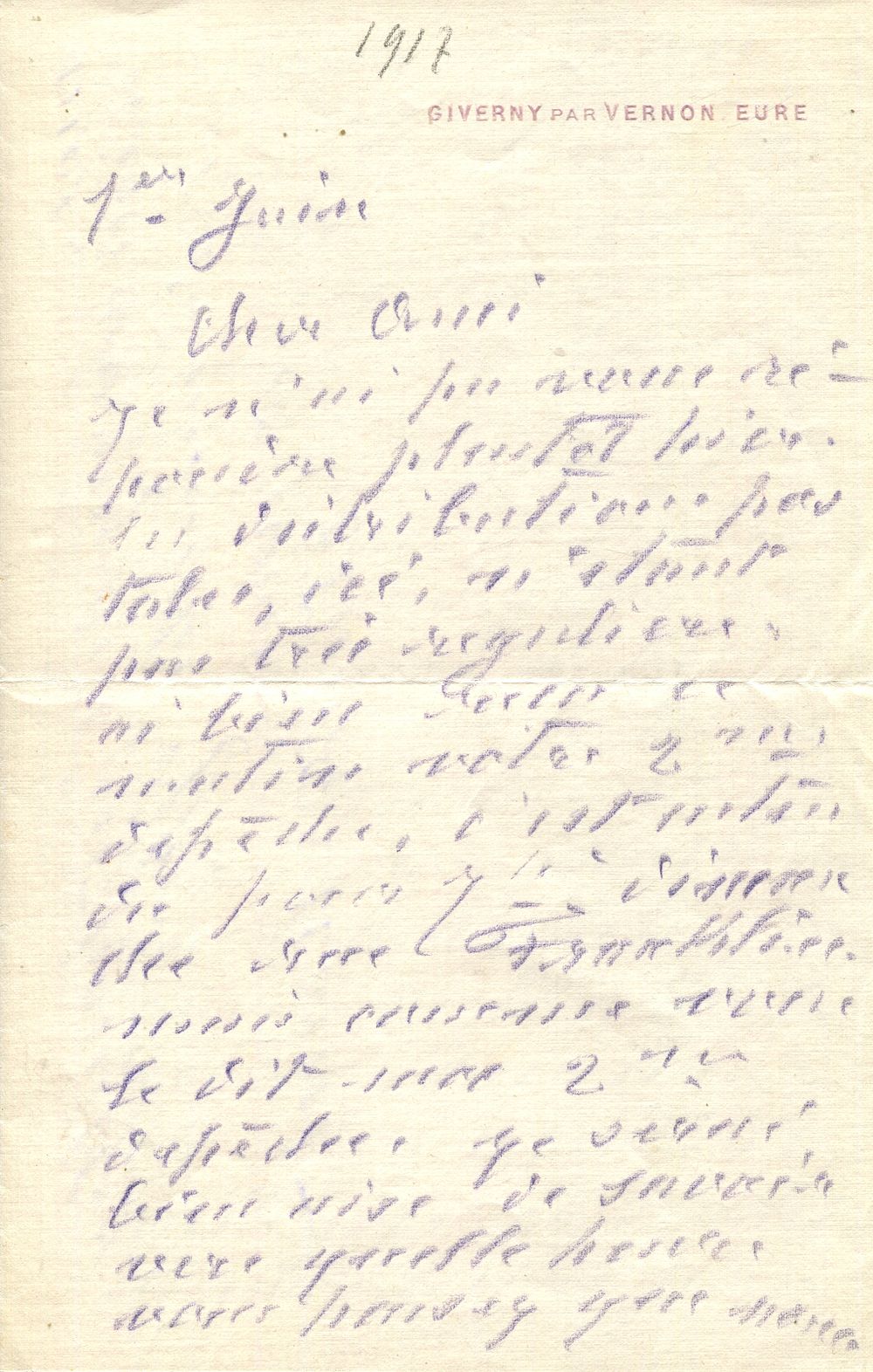
MONET CLAUDE: (1840-1926) - MONET CLAUDE: (1840-1926) French Impressionist painter. A very fine A.L.S., Claude Monet , three pages, 8vo, on his printed stationery of Giverny par Vernon, Eure, 1st June [1917], to Georges Clemenceau, in bold purple pencil, in French. In his characteristic writing Monet writes a letter to his lifelong friend Georges Clemenceau, referring to a travel they plan together to visit the bombed Reims cathedral, and explains that he wishes to make a quick visit to his son but as usual wishes to be back at work on Monday, and states in part ` Cher ami, je n´ai pu vous répondre plus tôt hier. Les distributions postales, ici, n´étant pas très régulières. Ai bien reçu ce matin votre 2eme dépêche, c´est entendu pour 7h dimanche rue Franklin... Je serai bien aise de savoir vers quelle heure vous pensez que nous [serons] de retour à Paris ne tenant pas à passer deux nuits à Paris, et voulant me mettre au travail dès lundi matin. Serait-il possible que je puisse embrasser mon fils qui se trouve à peu de distance de Reims entre Fismes et Craonne, exactement à Ventelay... Quelle joie ce serait et pour lui et pour moi. Vous verrez si c´est possible...´ (Translation: ” Dear friend, I was unable to reply to you earlier yesterday. The postal deliveries here are not very regular. I received your 2nd dispatch this morning, it is understood for 7am Sunday rue Franklin... I would be very happy to know around what time you think we [will be] back in Paris, not wanting to spend two nights in Paris, and wanting to get to work on Monday morning. Would it be possible for me to kiss my son who is a short distance from Reims between Fismes and Craonne, exactly at Ventelay... What a joy that would be for him and for me. You will see if it is possible...”) Accompanied by the original envelope, addressed in Monet´s hand, postmarked and stamped. Also including the permanent Certificate of exportation issued by the French Ministry of culture. In very good condition. VG to EX Georges Clemenceau (1841-1929) French Politician. Nicknamed ”the Tiger”. Clemenceau served as French Prime Minister from 1906 to 1909, and again from 1917 to 1920 and did much for the French victory during the First World War. Monet and Clemenceau met at the age of 20, but their friendship strengthened at the age of 50 when Clemenceau was finally introduced by the art critic Gustave Geoffroy in Monet’s house, in Giverny. Indeed, it was difficult to be greeted by Monet in his private paradise. Claude Monet was secretive and liked to work alone. But Clemenceau was an art lover, and the friendship between these two was unavoidable. They shared the same ideas on different things, like education and politics. Claude Monet offered to his friend Clemenceau the famous painting ” Le Bloc ” (” Block of Creuse rocks ”), now in the Royal collection in England. The title given to the painting refers to a sentence pronounced by Clemenceau in a speech of 1891 “ the French Revolution is a block ”. They both loved nature, shared bulbs and seeds. These two tireless workers have admired each other, waiting for the next time they will meet by writing letters. Some are funny because they use nicknames like ”my poor crustacean” or ”my old biped” They almost had an argument when Monet, who was working on the Water Lilies, wanted to stop, discouraged. Clemenceau wrote to Monet that he was ready to give up to their friendship if Monet gave us his job. These paintings, now in the Orangerie Museum, are important because they were offered to the French State by Monet the day after the Armistice of November 11th, 1918, to pay homage to the young men who died in the trenches. In January 1923, Clemenceau urged Monet to undergo an operation on the eyes. It was a small success, Monet could see the colors again, for the last 3 years of his life… It has been reported that the 5th of December 1926, Monet died of lung cancer. When Clemenceau received the phone call telling him that Monet was dying, he jumped into his car, and shouted every minute on his driver ” faster!!! ”. He arrived in Giverny, ran to Monet’s room, located on the second floor of the house, and took his friend in his arms. Monet died few minutes after. On the day of the funeral, a black drapery was placed over the coffin. Clemenceau, full of rage and energy, withdrew it, ran to the kitchen and took one of the yellow curtain, and said ” No black for Monet! Black is not a color! ”