Subasta Bidspirit | COSTA LUCIO: (1902-1998) Brazilian Architect.
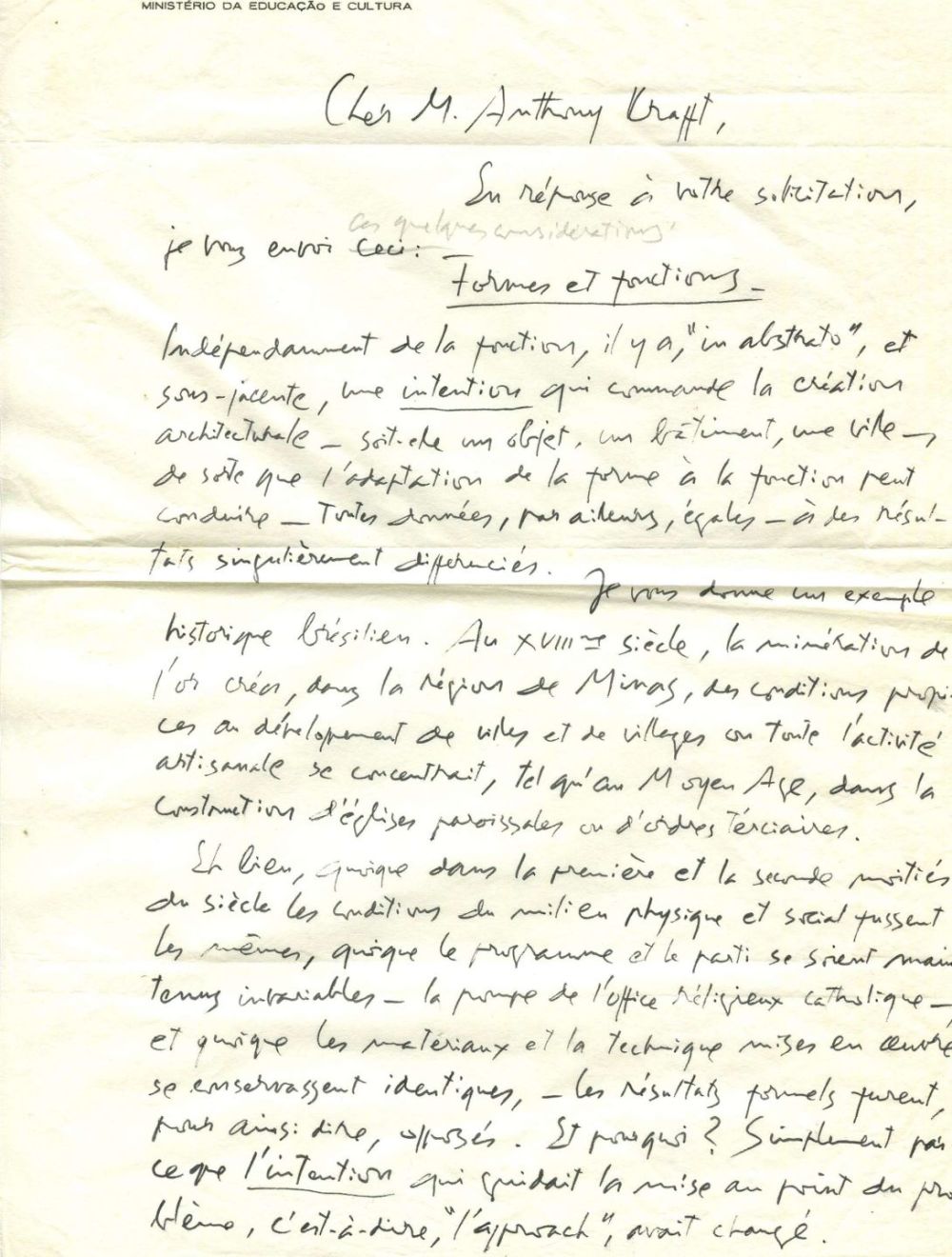
COSTA LUCIO: (1902-1998) Brazilian Architect. A renowned urban Planner, best known for his plan of B... - COSTA LUCIO: (1902-1998) Brazilian Architect. A renowned urban Planner, best known for his plan of Brasilia. An exceptional A.L.S., `Lucio Costa´, four pages, folio, Rio de Janeiro, 23rd May 1966, on the ''Ministerio da Educaçao e Cultura'' printed heading, to Anthony Krafft, in French. A very interesting letter, fully related to architecture, with Costa´s thoughts, and with multiple references to history, works and architects. Costa states in part `Indépendamment de la fonction, il y a ''in abstrato'' et sous-jacente, une intention que commande la création architecturale - soit-elle un objet, un batiment, une ville -, de sorte que l´adaptation de la forme a la fonction peut conduire a des résultats singulierement différenciés. Je vous donne un exemple historique Brésilien. Au XVIII siecle ´ (''Independently of the function, there is ''in abstrato'' and underlying, an intention that the architectural creation commands - be it an object, a building, a city - so that the adaptation of form to function can lead to singularly differentiated results. I will give you a Brazilian historical example. In the 18th century '') Costa continues with historical references and examples, saying `Dans la premiere moitié du siècle dominait encore l´esprit d´ostentation et d´opulence a la Louis XIV, - courbes et contre-courbes lourdes, de l´or, du bleu foncé, du rouge et du noir; dans la seconde période c´était déja l´élégance et la grace de l´esprit Louis XV qui prévalait: courbes et contre-courbes acquirent de la souplesse, l´emploi de l´or se fit moins ostensif, le bleu devint clair, le rouge rose, le blanc et le gris remplacerent le noir. Cela montre que la relation forme-fonction doit etre envisagée en tenant compte de l´intention qui commande le processus d´intégration formelle´ (''In the first half of the century, the spirit of ostentation and opulence in the Louis XIV style still dominated - heavy curves and counter-curves, gold, dark blue, red and black; in the second period it was already the elegance and the grace of the Louis XV spirit which prevailed: curves and counter-curves acquired suppleness, the use of gold became less ostensive, the blue became clear, pink instead of red, white and grey replaced black. This shows that the form-function relationship must be considered taking into account the intention that drives the process of formal integration'') Lucio Costa further refers to today´s date concepts and to Le Corbusier, stating in part `L´idéal de clareté et de pureté formelle géométrique de la Renaissance a refoulé en Europe la conception formelle dynamique (gothique). Aujourd´hui, grace a la technologie moderne qui permet des structures où la tension prédomine, on observe, un peu partout, le retour au dynamisme formel. Il y a meme les prétentieux de l´art dit prospectif qui prétendent ensevelir, des maintenant, avec son corps, l´oeuvre de Le Corbusier. Ils oublient sa belle structure (gothique) du toit suspendu de la grande salle du Palais des Soviets, le Pavillon improvisé de ''L´Esprit Nouveau'' (1937) et le Pavillon Philips de Bruxelles. Le Corbusier avait l´esprit ouvert a tous les vents. Dans sa premiere phase de conception statique prévalait, avec le contrepoint dynamique de sa peinture; apres Ronchamp l´intégration des deux concepts s´établit. L´intégration qui est le fondement meme de l´art des temps nouveaux´ (''The Renaissance ideal of clarity and geometric formal purity drove dynamic formal design (Gothic) back to Europe. Today, thanks to modern technology which allows structures where tension predominates, we can observe, almost everywhere, a return to formal dynamism. There are even the pretentious of the so-called prospective art who claim to bury, from now on, with his body, the work of Le Corbusier. They forget his beautiful structure (Gothic) of the suspended roof of the great hall of the Palace of the Soviets, the improvised Pavilion of ''L´Esprit Nouveau'' (1937) and the Philips Pavilion in Brussels. Le Corbusier was open to all new visions. In his first phase of static design prevailed, the dynamic counterpoint of his painting; after Ronchamp the integration of the two concepts was established. Integration which is the foundation itself of the art of the new times'') Further again Costa adds his conclusions on his function and form theory. VG Anthony Kraft (1928-1991) Swiss journalist and editor of architecture works.