Subasta Bidspirit | HUGO VICTOR: (1802-1885)
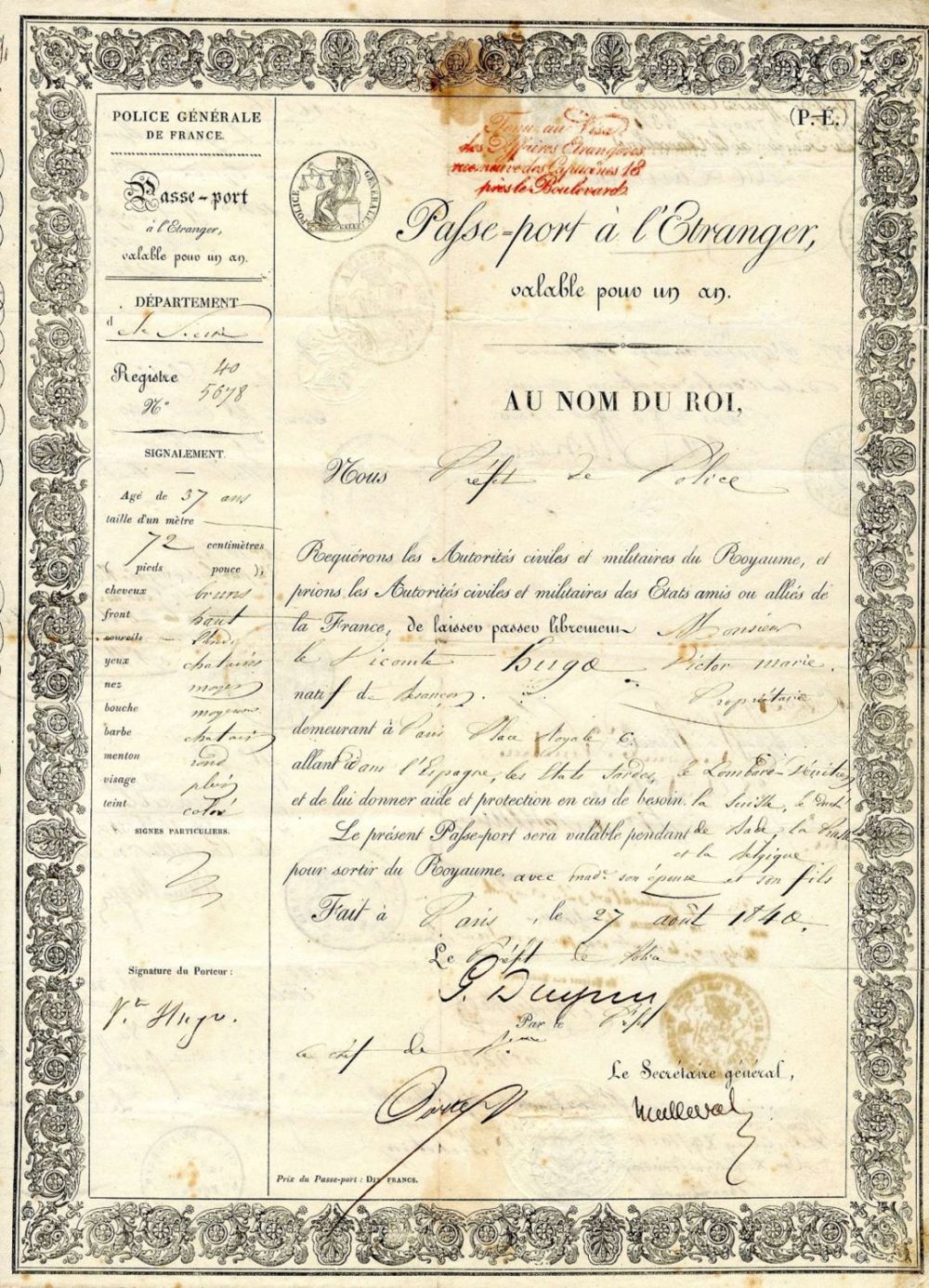
HUGO VICTOR: (1802-1885) - HUGO VICTOR: (1802-1885) French novelist, poet and dramatist. An excellent, significant and attractive D.S., Vtr. Hugo , one page, large folio (33 x 41.5 cm), Paris, 27 th August 1840, in French. The partially printed document (featuring an attractive printed border of decorative floral frieze work) is completed in manuscript and is the Passe-port a l'Etranger (Foreign Passport) issued to Hugo in the name of the King by the General Police of France (Department of the Seine) for the period of one year. The left margin is completed with various personal details and physical characteristics relating to the novelist, stating that he is aged 37, is one metre and seventy-two centimetres in height, has brown hair, a high forehead, chestnut eyes, a medium nose, a chestnut beard, and a round chin etc. The main body of the document states that Hugo, a native of Besancon and residing at 6 Place Royale in Paris, accompanied by his wife and their son, should be allowed free passage to visit Spain, the Sardinian States, Lombard-Venetia, Switzerland, the Duchy of Baden, Prussia and Belgium. Signed at the foot by the prefect of police and countersigned by two other officials. The verso of the document is filled with the various official stamps, visas and signatures of the officials of the legations, embassies and territorial authorities of the Duchy of Baden, Switzerland, Belgium, Spain, Sardinia, Prussia and Lombardy-Venetia, providing a valuable primary record of Hugo's travels during 1840 (the last entry at Forbach, Baden-Wurttemberg, bearing the date 29 th October 1840). Some light overall age wear and with a few minor, neat tears to the edges, about VG Hugo's passport for the year 1840 is of literary significance as it was from August to October of that year that the novelist, in the company of his mistress and travelling companion Juliette Drouet, made their summer trip to Belgium and then from Cologne to Mainz, on the banks of the Rhine, the landscape and history of which greatly fascinated the novelist. After an excursion to Frankfurt, the couple travelled to Heidelberg to visit the Rhine falls at Laufen, near Schaffhausen. During the trip Hugo kept a diary and made various drawings which would form the basis of his travel guide Le Rhin (1842), a work which marked the rebirth of romance in the novelist's works.