Subasta Bidspirit | STREPPONI GIUSEPPINA (1815-1897)
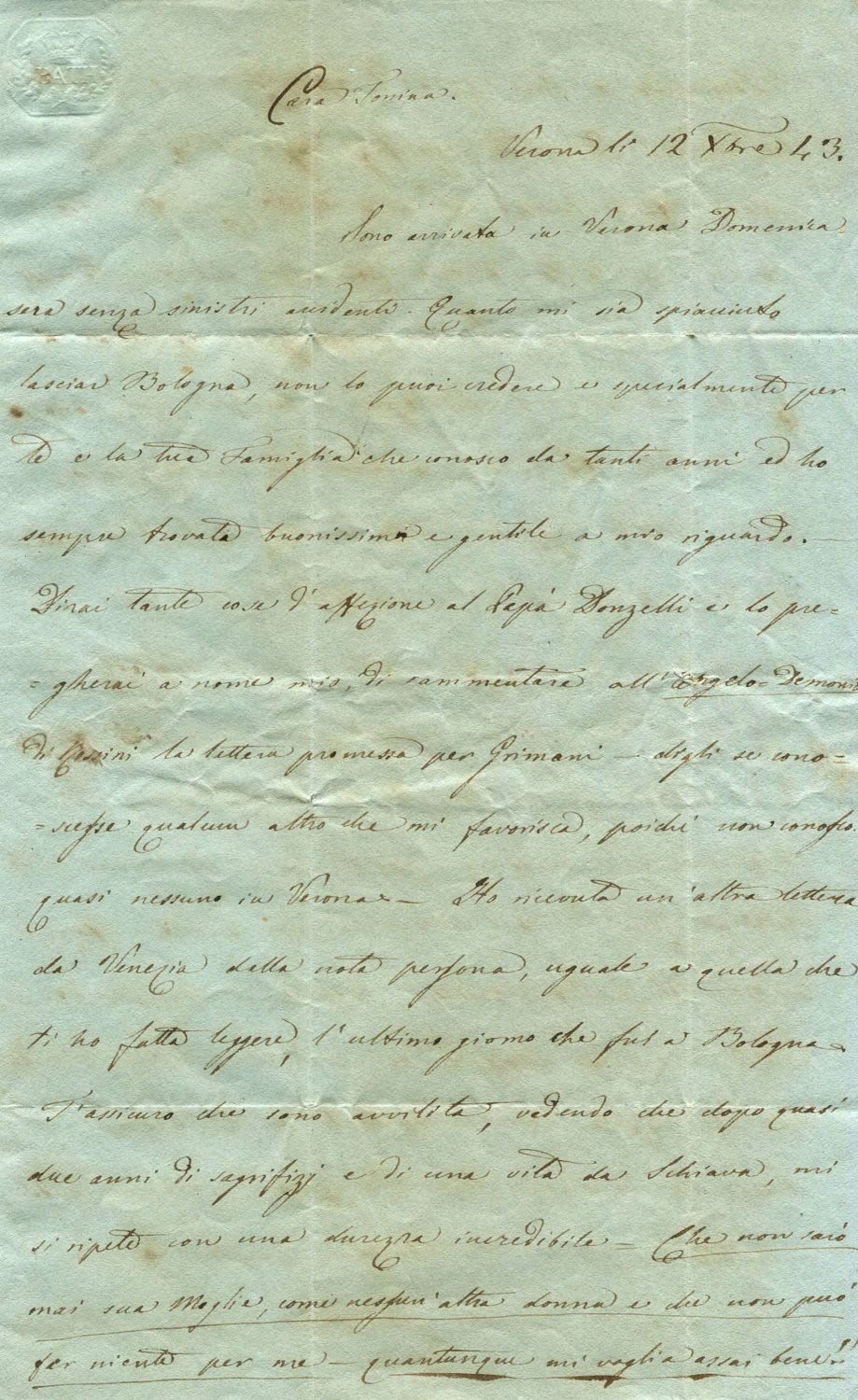
STREPPONI GIUSEPPINA (1815-1897) - STREPPONI GIUSEPPINA (1815-1897) Italian Soprano of great renown who excelled in the Bel Canto repertoire. Strepponi was the second wife of Giuseppe Verdi and starred in many of his early operas, including the role of Abigaille in the premiere of Nabucco (1842). She retired at the very early age of 30. Her personal relationship with Verdi lasted 50 years until her death. A good A.L.S., ` L´amica G. Strepponi´, three pages, 8vo, Verona, 12 th December 1843, to Antonietta Donzelli, in Italian. A very interesting and early letter of good association, Strepponi stating in part ` Quanto mi era spiaciuto lasciar Bologna, non lo puoi credere e specialmante per te e la tua famiglia… Dirai tante cose d´affezione al Papà Donzelli e lo pregherai a nome mio, di rammentare all´ Angelo Demonio di Rossini la lettera promessa… digli se conoscesse qualcuno altro che mi favorisca, poiché non conozco quasi nessuno in Verona´ (Translation: ` How sorry I was to leave Bologna, you cannot believe it and especially for you and your family… You would say so many things of affection to Papa Donzelli, and ask him in my name to remind the Angel-Demon of Rossini the promised letter… tell him if he knows someone else who favours me, since I hardly know anyone in Verona´) Strepponi further refers to a man that her correspondent knows, avoiding to mention his names, saying ` Ho ricevuta un´altra lettera da Venezia dalla nota persona, uguale a quella che ti ho fatto leggere l´ultimo giorno che fui a Bologna. T´assicuro che sono avvilita, vedendo che dopo quasi due anni di sagrifizi e di una vita da Schiava, mi si ripete con una dureza incredibile: che non saró mai sua Moglie come nessun´altra donna e che non puó far niente per me - quantunque mi voglia assai bene !!´ (Translation: ` I have received another letter from Venice from the well-known person, same as the one I let you read on the last day I was in Bologna. I assure you that I am disheartened seeing that after almost two years of sacrifices and a life as a Slave, he repeats himself to me with incredible harshness: that I will never be his Wife, like no other woman, and that he cannot do anything for me - although he loves me very much !!´) Strepponi wonders what kind of affection is that one, saying ` Domando io che razza d´affezione sia quest ache desidera ed accetta sagrifizi dagli altri, senza volerne fare alcuno!´ (Translation: ` I wonder what kind of affection is this one who desires and accepts sacrifices from others, without wanting to make any!´) Further again Strepponi asks for secrecy, stating ` Conserva la massima segretezza su questo affare… Mi raccomando alla Madonna, perché m´aiuti e mi meta nella posizione di non calcar mai piú quelle infami tavole del palcoscenico, e spero m´esaudisca´ (Translation: ` Keep the utmost secrecy on this matter ... I commend myself to the Madonna, to help me and put me in the position of never again treading those infamous stages, and I hope she will listen to me´) Before concluding Strepponi refers to Verdi and to his opera Nabucco which she premiered a year and a half earlier, stating ` Vitali ha preso alloggio senza dirmi nulla; si vede che sua moglie non era contenta di star meco. Para che vi sia qualche intenzione di chiamar Verdi a mettere in scena il Nabucco, sarebbe da una parte meglio, perché potressimo parlar chiaro´ (Translation: ` Vitali has taken lodges without telling me anything; it is evident that his wife was not happy to be with me. It seems that there is some intention of calling Verdi to stage Nabucco, on the other hand it will be better, because we will be able to speak clearly´) The letter bears a Bath blind embossed seal to the upper left corner. With address leaf, postmarked and with remnants of a former red wax seal. Accompanied by a full typed transcription of the letter. Overall creasing. About G In 1844, few months after the present letter was written, Strepponi began to experience significant vocal problems, most likely brought on by her relentless performing schedule. Her voice never recovered and she thereafter appeared only sporadically in operas until her retirement in February 1846