Subasta Bidspirit | WORLD WAR II:
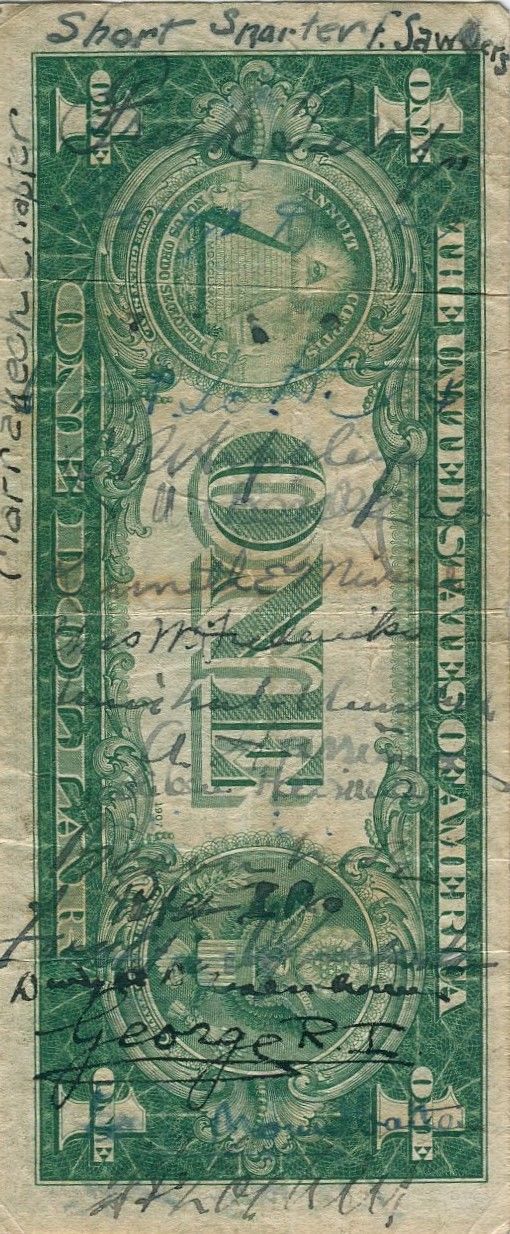
WORLD WAR II: - An exceptional and extremely rare vintage multiple signed ‘Short Snorter’, the American One Dollar bank note, featuring over twenty five signatures, including ‘The Big Three’ of Churchill, Roosevelt and Stalin, and many other leading political and military figures of World War II, all collected by Frank Sawyer, valet to Winston S. Churchill, at various historic meetings between 1939-45. The identified signatories on the ‘Short Snorter’ are -Winston S. Churchill (1874-1965) British Prime Minister 1940-45, 1951-55. At the outbreak of World War II Churchill was appointed First Lord of the Admiralty and, following the resignation of Neville Chamberlain, became Prime Minister in 1940. His speeches and radio broadcasts helped inspire British resistance, especially during the difficult days of 1940-41 when the British Commonwealth and Empire stood almost alone in its active opposition to Adolf Hitler. Churchill led Great Britain as Prime Minister until victory over Nazi Germany had been secured.Franklin D. Roosevelt (1882-1945) American President 1933-45. Following the attack by the Japanese on Pearl Harbor in December 1941, Roosevelt obtained the approval of the United States Congress to declare war on Japan and, a few days later, Germany. The President worked closely with Winston S. Churchill and Joseph Stalin (as well as Chinese Generalissimo Chiang Kai-shek) in leading the Allies against Nazi Germany, Fascist Italy and Imperial Japan in World War II. ‘The Big Three’ of Roosevelt, Churchill and Stalin met regularly during World War II, most notably at the Tehran Conference (1943) and the Yalta Conference (1945).Joseph Stalin (1878-1953) General Secretary of the Central Committee of the Communist Party of the Soviet Union 1922-52. Stalin met Winston S. Churchill and/or Franklin D. Roosevelt in several conferences during World War II to plan military strategy and, later, to discuss Europe’s post-war reorganisation. The earlier conferences, such as that with British diplomats in Moscow in 1941, and with Churchill and American diplomats in Moscow in 1942, largely focused on war planning and supply. In 1943 Stalin met Churchill and Roosevelt at the Tehran Conference and in the following year the Soviet dictator met Churchill at the Moscow Conference. In February 1945, at the Yalta Conference, Stalin demanded a Soviet sphere of political influence in Eastern Europe. He was eventually convinced by Churchill and Roosevelt not to dismember Germany.King George VI (1895-1952) King of the United Kingdom 1936-52. In 1939, following Britain’s declaration of War on Nazi Germany, King George VI and his consort, Queen Elizabeth, resolved to stay in London and reside at Buckingham Palace despite the German bombing raids (one of which nearly killed them). Throughout World War II King George VI made various morale boosting visits and travelled to see Allied military forces abroad in France in December 1939, North Africa and Malta in June 1943, Normandy in June 1944, southern Italy in July 1944 and the Low Countries in October 1944. Each Tuesday for four and a half years from September 1940 King George VI met privately with Winston S. Churchill for lunch in order to discuss the war in in secret and with frankness, developing into ‘the closest personal relationship in modern British history between a monarch and a Prime Minister’.Anthony Eden (1897-1977) 1st Earl of Avon. British Prime Minister 1955-57, succeeding Winston S. Churchill after having served as his deputy for almost fifteen years. Eden served as Foreign Secretary on three occasions, including a spell for most of World War II from 1940-45, and also briefly served as Secretary of State for War in 1940. Eden was one of Churchill’s closest confidants, however his role during the war as Foreign Secretary was restricted as Churchill himself conducted the most important negotiations with Franklin D. Roosevelt and Joseph Stalin. Despite this Eden served loyally as Churchill’s lieutenant and was present at the Quebec Conference in 1943 and the Potsdam Conference in 1945.Louis Mountbatten (1900-1979) 1st Earl Mountbatten of Burma. British Admiral of the Fleet. Mountbatten, a favourite of Churchill, served as Supreme Allied Commander, South East Asia Command from 1943-46. He also accompanied Churchill to his meeting with Franklin Roosevelt in French Morocco, known as the Casablanca Conference, in January 1943 (which Stalin declined to attend).Harold Alexander (1891-1969). 1st Earl Alexander of Tunis. British Field Marshal. Alexander oversaw the final stages of the Allied evacuation from Dunkirk and later held high ranking field commands in Burma, North Africa and Italy, including serving as Commander-in-Chief Middle East and commanding the 18th Army Group in Tunisia. Alexander then commanded the 15th Army Group for the capture of Sicily and ended the war as Supreme Allied Commander Mediterranean.Alan Brooke (1883-1963) 1st Viscount Alanbrooke.