Subasta Bidspirit | [TALLEYRAND-PÉRIGORD CHARLES MAURICE DE]: (1754-1838)
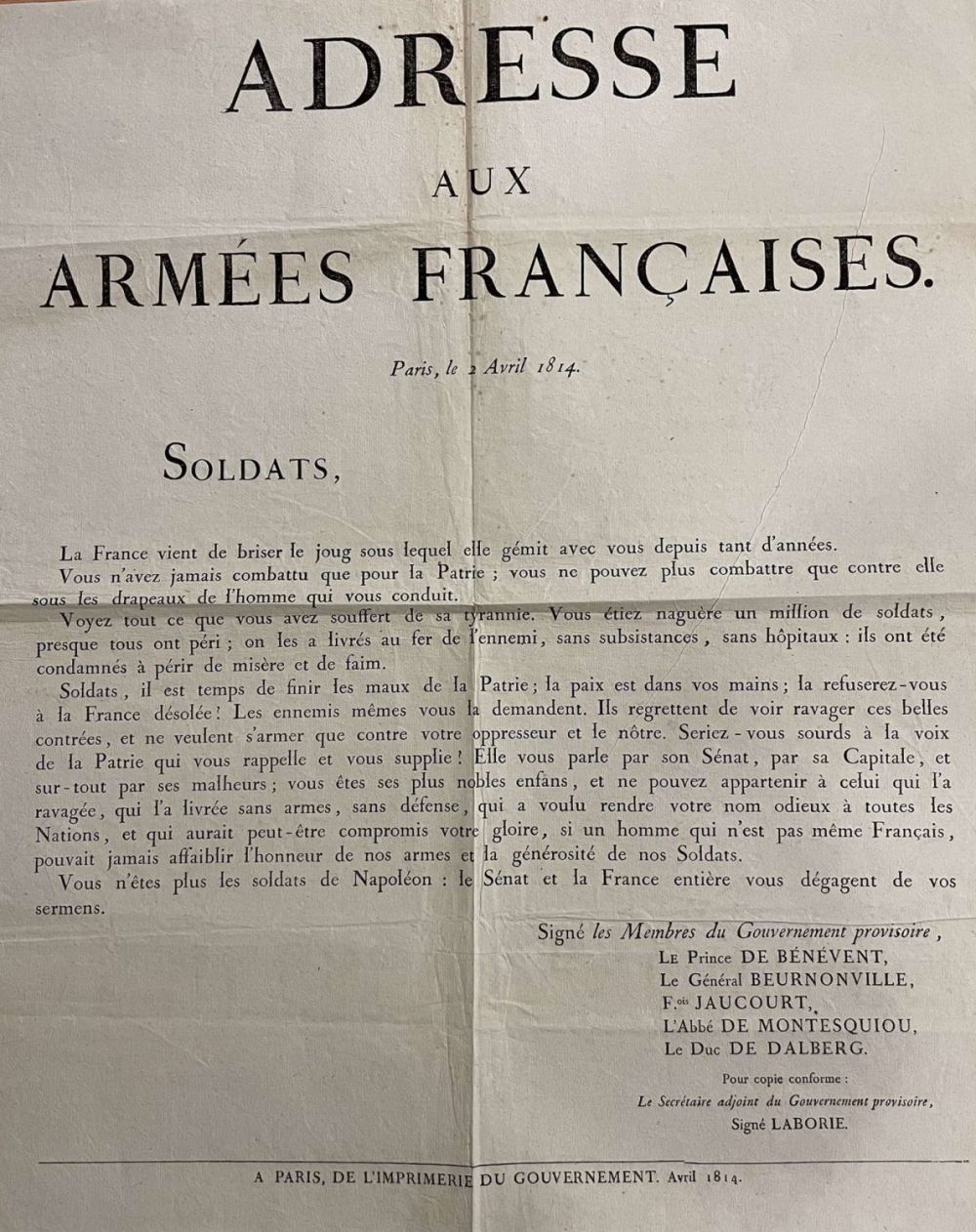
[TALLEYRAND-PÉRIGORD CHARLES MAURICE DE]: (1754-1838) French Diplomat and Statesman. Prime Minister of - [TALLEYRAND-PÉRIGORD CHARLES MAURICE DE]: (1754-1838) French Diplomat and Statesman. Prime Minister of France July-September 1815. A Rare original 16 x 20 printed public notice, one page, Paris, 2nd April 1814, in French. The affiche bears the printed heading ''To French Armies'', and states in part ''Soldiers, France has just broken the yoke under which was moaning for so many years. You have always and only fought for your Homeland, but now you can only fight against it under the flags of the man who guides you. See how much you have suffered because of his tyranny. You were once one million of soldiers, almost all have perished. They were sent to battle, without support, without hospitals, they were condemned to die in misery and hunger. Soldiers, it is time to put an end to the evils of the Homeland. Peace is in your hands.'' The poster affiche includes a lengthy harangue, intending to convince the French troops to give up the fight, and states before concluding ''You are not any more the soldiers of Napoleon, the Senate and the whole of France release you all from your oaths.'' At the base the call bears the printed names of the ''Members of the provisional government - Le Prince de Bénévent - Le General Beurnonville - F. Jaucourt - L´Abbé de Montesquiou - Le Duc de Dalberg'' Folded, very small minor creasing, G to VG On 1st of April 1814, the day before the present affiche was issued, the French Senate appoints a provisional government headed by Talleyrand. On 2nd April, as the affiche states, the Senate declares Napoleon Bonaparte and his family deprived of the throne, and the French people and army freed from their oath of fidelity. Two days later, on 4th of April, Napoleon signs at Fontainebleau a form of conditional abdication, which preserves the rights of his son and the Empress Regent. On 6th of April Napoleon renounces for himself and his family to the thrones of France and Italy.