Subasta Bidspirit | THOULESS DAVID J.: (1934-2019) British
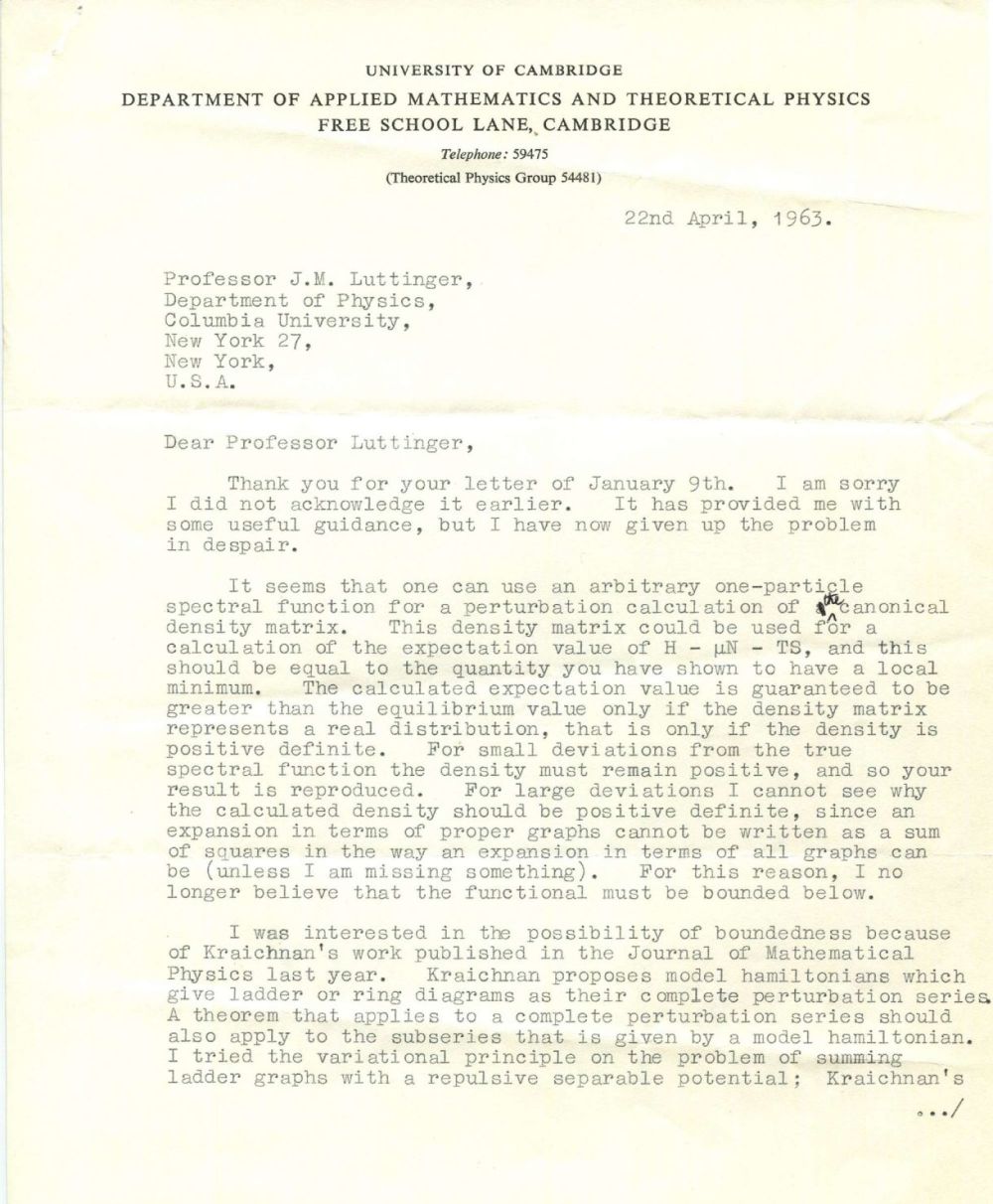
THOULESS DAVID J.: (1934-2019) British Physicist, Nobel Prize winner for Physics, 2016. T.L.S., D. J... - THOULESS DAVID J.: (1934-2019) British Physicist, Nobel Prize winner for Physics, 2016. T.L.S., D. J. Thouless, two pages, 4to, Cambridge, 22nd April 1963, to Professor J. M. Luttinger of Columbia University, on the printed stationery of the Department of Applied Mathematics and Theoretical Physics at the University of Cambridge. Thouless thanks his correspondent for their letter, remarking 'It has provided me with some useful guidance, but I have now given up the problem in despair' and continuing to explain 'It seems that one can use an arbitrary one-particle spectral function for a perturbation calculation of the canonical density matrix The calculated expectation value is guaranteed to be greater than the equilibrium value only if the density matrix represents a real distribution, that is only if the density is positive definite. For small deviations from the true spectral function the density must remain positive, and so your result is reproduced. For large deviations I cannot see why the calculated density should be positive definite, since an expansion in terms of proper graphs cannot be written as a sum of squares in the way an expansion in terms of all graphs can be (unless I am missing something). For this reason, I no longer believe that the functional must be bounded below', further adding 'I was interested in the possibility of boundedness because of Kraichnan's work published in the Journal of Mathematical Physics last year. Kraichnan proposes model hamiltonians which give ladder or ring diagrams as their complete perturbation series. A theorem that applies to a complete perturbation series should also apply to the subseries that is given by a local Hamiltonian. I tried the variational principle on the problem of summing ladder graphs with a repulsive separable potential; Kraichnan's methods show that the energy obtained should be no less than the Fermi kinetic energy. I could, in certain cases, choose propagators that gave exactly the Fermi kinetic energy for the functional. If I could show that the functional can be further reduced I would have found a counter-example to the boundedness hypothesis, but I have not managed to do this'. A good letter of scientific content and association. The two pages stapled together in the upper left corner and with some light creasing, otherwise VG Joaquin Mazdak Luttinger (1923-1997) American Physicist.