Subasta Bidspirit | HERZBERG GERHARD: (1904-1999)
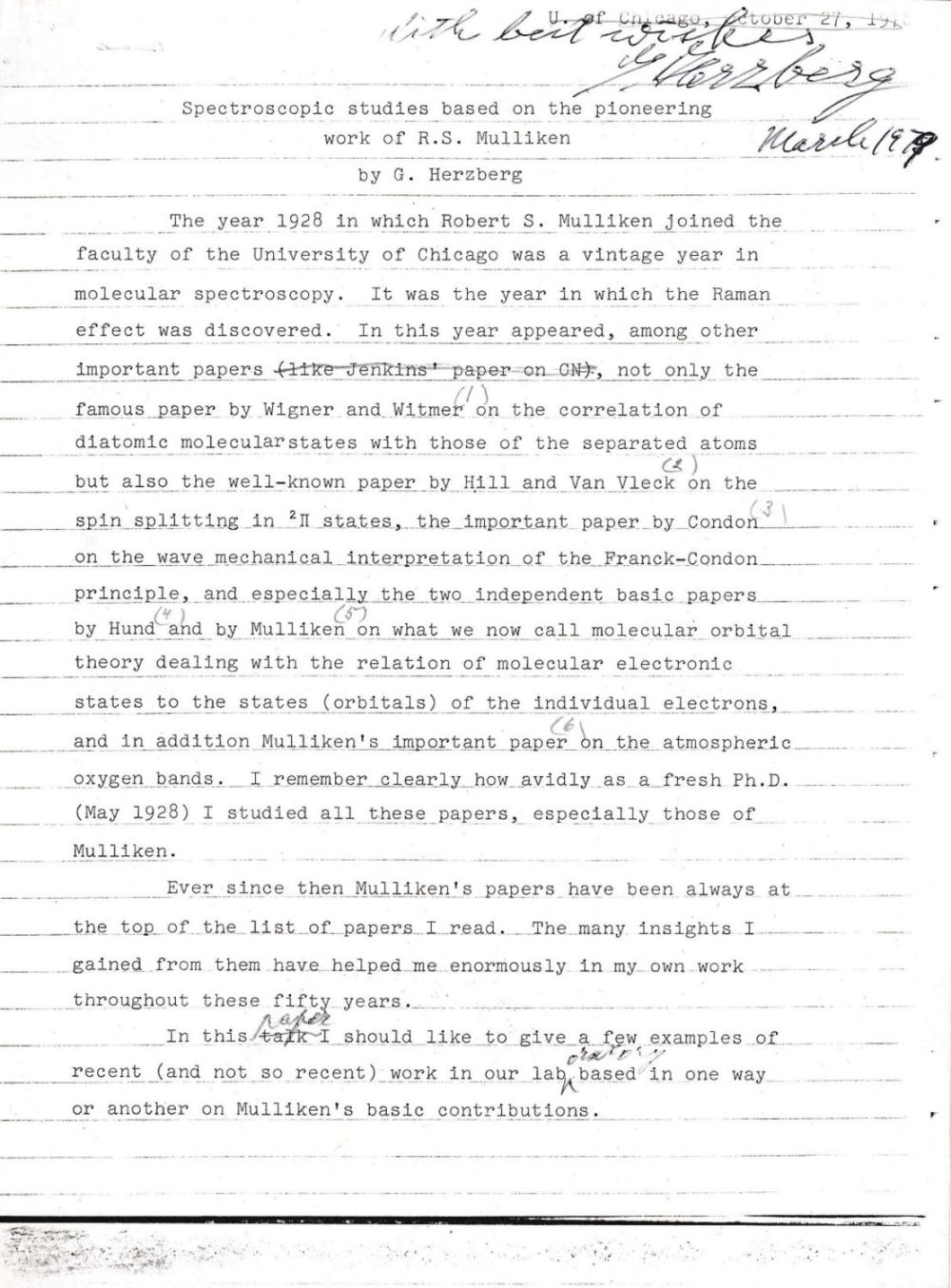
HERZBERG GERHARD: (1904-1999) - HERZBERG GERHARD: (1904-1999) German-Canadian Physicist and Physical Chemist, Nobel Prize winner for Chemistry, 1971. Manuscript Signed, G Herzberg , twenty-four pages, 4to, n.p. (University of Chicago?), March 1979. The typed manuscript (the first page of which is a photostat copy, although with an ink signature) bears extensive holograph corrections and additions in pencil, was written in October 1978 and is entitled Spectroscopic Studies based on the Pioneering Work of R. S. Mulliken and commences, in part, ‘The year 1928 in which Robert S. Mulliken joined the faculty of the University of Chicago was a vintage year in molecular spectroscopy. It was the year in which the Raman effect was discovered. In this year appeared, among other important papers…..the two independent basic papers by Hund and by Mulliken on what we now call molecular orbital theory dealing with the relation of molecular electronic states to the states (orbitals) of the individual electrons, and in addition Mulliken’s important paper on the atmospheric oxygen bands. I remember clearly how avidly as a fresh Ph.D. (May 1928) I studied all these papers, especially those of Mulliken. Ever since then Mulliken’s papers have been always at the top of the list of papers I read. The many insights I gained from them have helped me enormously in my own work throughout these fifty years. In this paper I should like to give a few examples of recent (and not so recent) work in our laboratory based in one way or another on Mulliken’s basic contributions’ , continuing to discuss Mulliken’s important work on Rydberg series in hydrogen between 1964-69, and the Rydberg series in nitrogen, van der Waals maxima in excited states of H 2, Condon diffraction bands in H 2 and D 2, the spectra of the HeNe+ and HeAr+ ions, and the spectra and structures of H 2 0+ and N H 3 +, and concludes ‘The examples of my own work based on Robert Mulliken’s seminal contributions could be amplified by examples from the work of almost every molecular physicist and spectroscopist. They show how enormously fruitful Mulliken’s ideas put forward over the last 50 years have been in his chosen field…..’ Together with Herzberg’s entirely holograph bibliography for the paper, two pages, 4to, n.p. (University of Chicago?), n.d. (October 1978), comprising a list of more than fifty titles, in bold pencil. A few very small, minor staple holes to the upper left corner of each page, VG Robert A. Mulliken (1896-1986) American Physicist & Chemist, Nobel Prize winner for Chemistry, 1966.