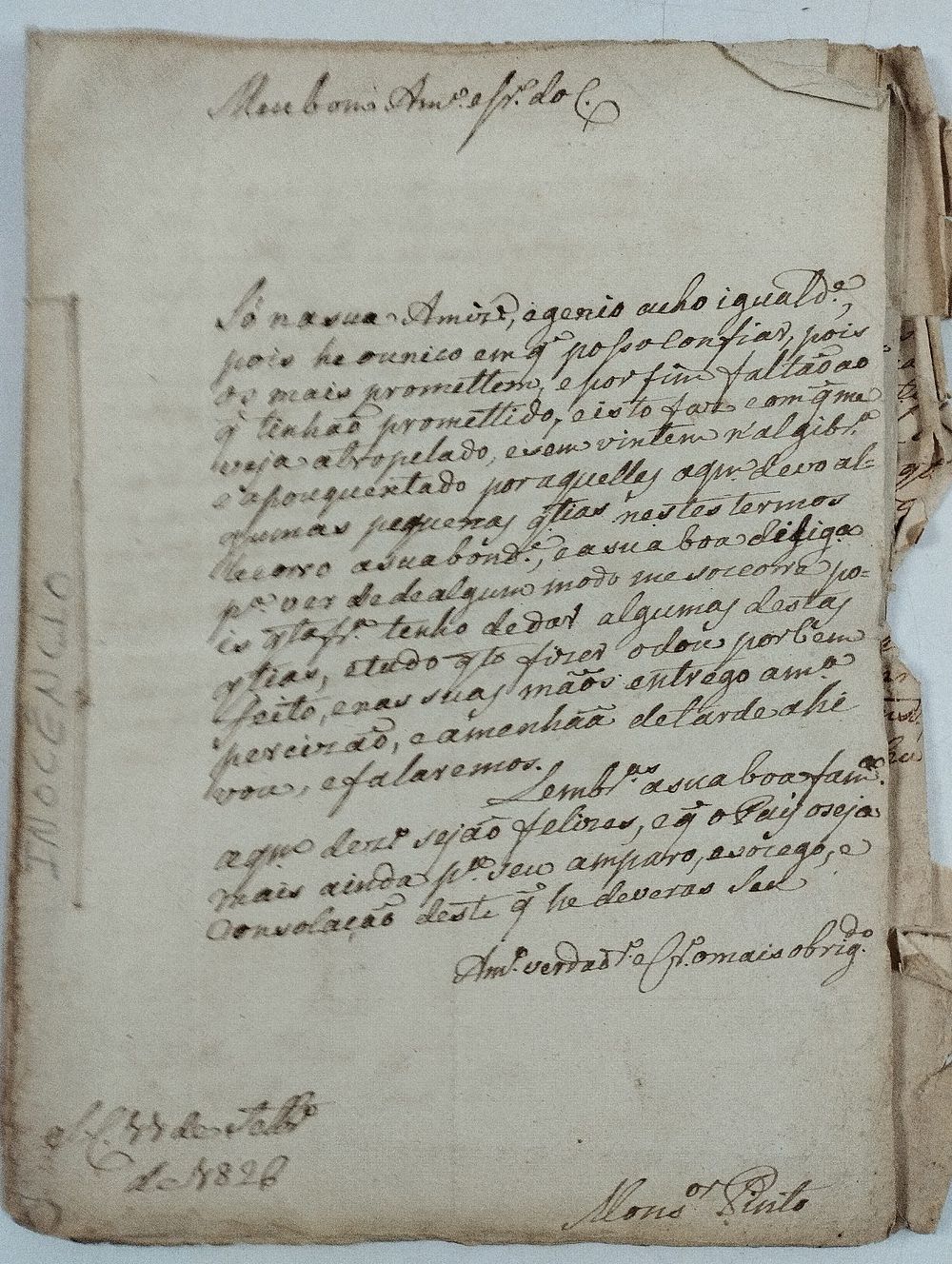
Subasta Bidspirit | PINTO (Monsenhor). CARTAS autógrafas assinadas,
PINTO (Monsenhor). CARTAS autógrafas assinadas, cosidas em caderno. [Lisboa]. 1826–1828. - PINTO (Monsenhor) CARTAS autógrafas assinadas, cosidas em caderno . [Lisboa], 1826–1828. 17 cartas manuscritas sobre papel, cosidas em caderno; 220 mm. A collection of seventeen handwritten letters signed by ”Monsignor Pinto, ” written between July 22, 1826, and October 1828, and bound in a booklet. They are addressed to a friend and benefactor, referred to as ”Friend and Lord of the Heart, ” to whom the signatory, a clergyman burdened with debt, turns in a tone that is sometimes confidential and sometimes supplicant. The dominant theme is money: requests for help or extensions, small remittances, orders for clothing (a vest, handkerchiefs), debts to a José Diniz Thomaz, to the tailor and the barber, and losses from discounting banknotes and bills, the credit paper then in circulation. Also appearing are the author's illness, toothaches, the death of a sister, and an allusion to the Chief of Police. In the letters from 1827 and the beginning of 1828, the author awaits the arrival of the Infante, from whom he expects justice and the restitution of what was taken from him; everything indicates that this refers to Infante D. Miguel, who returned to Lisbon in February 1828, which places the signatory in the ecclesiastical circle close to the Infante and gives the collection interest for portraying daily life during the political crisis that preceded the Civil War. The recipient is Inocêncio Francisco da Silva, a name given in full in the marginal notes (”Innocencio Fr.co da Sa”), and one of the letters includes the indication of major in the Legion of St. Peter of Alcântara, dated September 15, 1827. This rank in 1827 cannot be that of the homonymous bibliographer, author of the Diccionario Bibliographico Portuguez , born in 1810, so we believe his father, of the same name, was the recipient, and the notebook must have reached his son later. Private correspondence, directly and expressively readable, coherently gathered in a single notebook. Curious. List of letters, in chronological order: 1. July 22, 1826: He trusts only in the recipient's friendship, because others have failed to keep their promises; he asks for help to pay small debts and suggests they talk the following afternoon. 2. March 24, 1827: He apologizes for any mistrust and requests, if possible, assistance without inconveniencing the recipient; he affirms his gratitude. 3. April 18, 1827: Very mortified and distressed, he asks that you remedy his situation with whatever you can, as he is without money. 4. October 13, 1827: Ashamed of not being able to fulfill his obligations; he mentions his sister's death, the expenses it caused, and the decrease in income, having already sold and mortgaged everything. 5. October 25, 1827: He acknowledges an offer of help, but refuses it because he does not want to increase his debts; he requests assistance in writing and hopes that the arrival of the Infante will bring him justice. 6. October 27, 1827: He asks that a waistcoat and two handkerchiefs be brought to him and complains of toothache. 7. November 6, 1827: He sends twenty-seven tostões and asks for patience, saying he is being persecuted from all sides. 8. [8] of [November] 1827: Brief note in which he asks for the favor of a purchase; reading to be confirmed. 9. [16] of [November] 1827: He intended to send the amount for the waistcoat, but he did not receive what he expected and was left without money; he asks for patience. 10. [26] of [November] 1827: He received the handkerchiefs; he informs Guimarães what he still owes and asks what time he can go to his friend's house. 11. [?] December 1827: He needs three white handkerchiefs and asks for an arrangement to pay the tailor, promising the money soon. 12. sd [before February 1828]: An attack of illness prevented him from writing; distressed by debts, he hopes that the arrival of the Infante will restore what was taken from him; incomplete letter in the images. 13. May 6, 1828: Now in better health, he does not deny what he owes and hopes to redeem himself this month; he laments the afflictions of his friend. 14. July 3, 1828: Failure to fulfill promises regarding losses in the discounting of banknotes and tickets; alludes to the Chief Intendant of Police. 15. [?] of July 1828: Informs that a banknote is in the hands of a person, at José Diniz Thomaz's store, and that he will notify as soon as he has it. 16. September 27, 1828: He declares his debts, among them twenty-two thousand and four hundred réis to José Diniz Thomaz, rejects the offer received and promises to pay the following day. 17. October 5, 182[8]: He laments the losses in the discounts on the banknotes and says he will speak to José Diniz. ⚑ Auto-translated via Google Translate